

X/Twitter for SaaS Founders: The Distribution Playbook

Score your founder account before you rebuild the funnel
Distribution starts with the account. Consistency, reply targeting, content mix and profile graded out of 100 with a worst-first fix list — then run the playbook on a profile that converts.
Learning how to grow on Twitter as a SaaS founder isn't about going viral. It's about picking three content pillars, writing in your real voice, replying where your buyers already are, and building a quiet funnel from X to email to trial to paid.
Most founders treat X like a billboard. They post a launch tweet, get a handful of likes from friends, and conclude the platform "doesn't work for B2B." The ones who win treat it as a distribution channel — a place where the few hundred people in your niche see your thinking, trust you over weeks, and sign up when they're ready. This post is the founder-specific playbook for exactly that: positioning, content pillars, the build-in-public tweet formula, reply targeting, and the funnel that turns attention into revenue.
Why Is X Still the Best Distribution Channel for SaaS Founders?
X is still the best free distribution channel for SaaS founders because the people who buy software — developers, indie hackers, operators, and startup decision-makers — are concentrated there in a way no other platform matches. You don't need a million followers. You need the few hundred people in your niche to see your thinking repeatedly until they trust you. A single useful reply on a larger account's tweet can dramatically out-reach your own posts: founders routinely report a thoughtful reply pulling around 12,000 impressions versus 400 on an original post — roughly 30x the eyeballs. That asymmetry is the whole opportunity. Unlike paid ads, the cost is your time and your taste. Unlike SEO, it compounds in weeks, not quarters. And unlike LinkedIn, the tone rewards directness over polish — which suits a founder who'd rather build than market. The catch: it only works if you show up consistently and sound like a person, not a press release.
What Are the 3 SaaS Content Pillars You Should Post About?
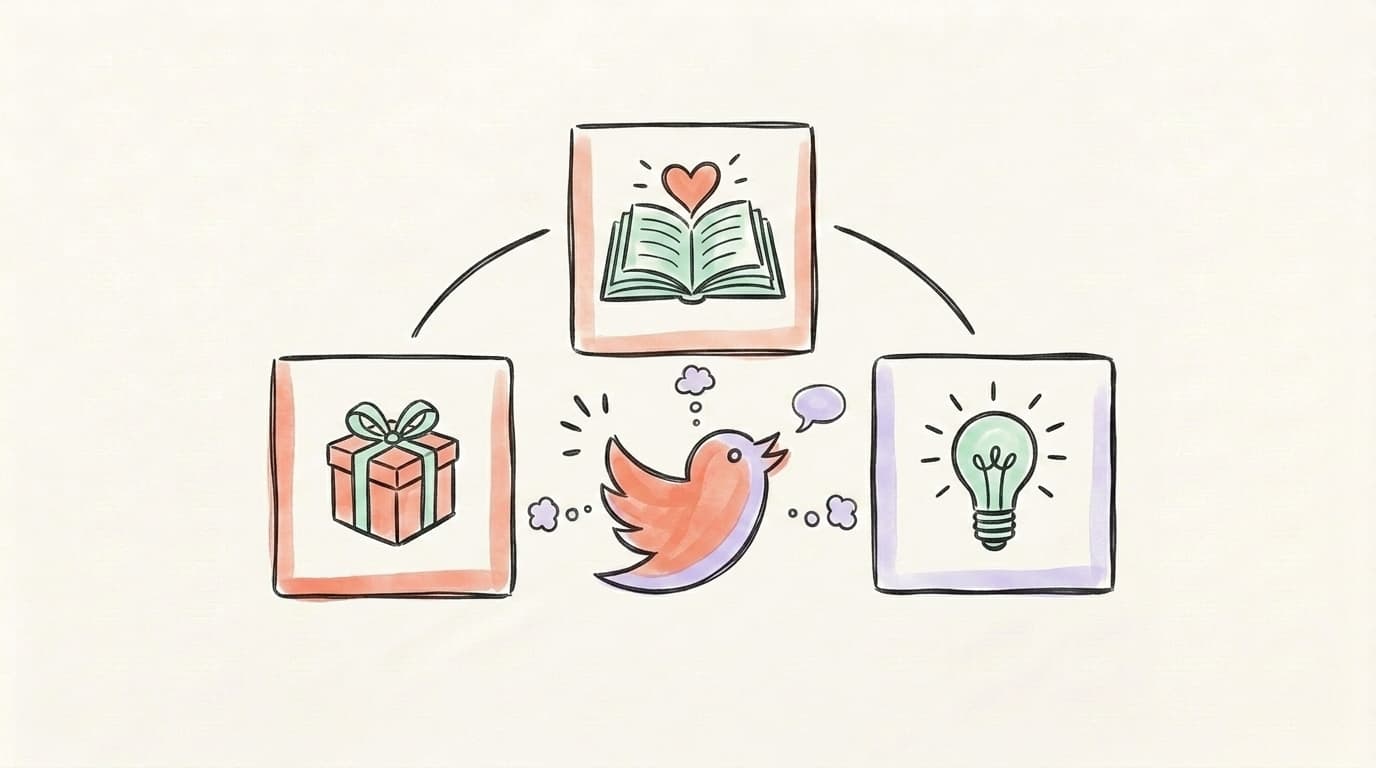
The three content pillars every SaaS founder should rotate through are Product, Story, and Insight — each doing a different job in the funnel. Product posts show the thing you're building in context (a feature solving a real problem, a before/after, a tiny demo clip). Story posts share the human journey: the bug that cost you a weekend, the churn that stung, the milestone that surprised you. Insight posts give away domain knowledge — opinions, frameworks, and lessons your buyers can use even if they never pay you. Most founders over-index on Product and wonder why nobody engages. The fix is a deliberate mix. A widely cited content ratio is roughly 80% value, 20% promotion — meaning Story and Insight should outnumber Product posts by a wide margin. The product still gets sold; it just rides in on content people actually want to read.
Here's how the three pillars break down in practice:
- Product (15-20% of posts): "We just shipped X. Here's the one problem it kills." Always tie the feature to a pain, never a feature list.
- Story (35-40%): Wins, losses, decisions, and metrics. Vulnerability earns trust — and trust is what converts later.
- Insight (40-45%): Teach what you know. The founder who freely shares how they think becomes the obvious person to buy from.
AI that learns your voice
Posts that actually sound like you
Postory's AI writes drafts in your voice — not generic AI mush — so you publish faster and still sound human.
Rotate them. If three posts in a row are about your product, you've drifted. Pull back to Story or Insight before your timeline starts reading like an ad.
Why Does Polished, Corporate Tweeting Hurt SaaS Founders?
Polished, corporate tweeting hurts SaaS founders because it signals "marketing," and marketing is exactly what people scroll past. The founder advantage on X is that you can sound like a human — and humans trust other humans, not brand accounts. When you write "We're thrilled to announce our latest feature release," you've told the reader to disengage. When you write "Spent 3 days fixing a bug that turned out to be one missing line. Shipped the fix. Here's what broke," you've told a story they'll actually read. The guidance from founders who grow fastest is blunt: write like you talk — short sentences, honest observations, real opinions. Polish creates distance. Roughness creates connection. This doesn't mean sloppy — typos and unclear posts still hurt — it means unguarded. Use your real face as your avatar, not a logo. Share the messy middle, not just the highlight reel. The voice that converts is the one that sounds like a DM to a friend, not a quarterly update to a board.
This is also the hardest part to outsource — a ghostwriter or generic AI can mimic structure but not the specific texture of your founder voice, the way you'd actually phrase a frustration or a win.
How Do You Write a Build-in-Public or Launch Tweet That Actually Lands?
A build-in-public or launch tweet lands when it leads with a concrete number or moment, not an announcement. "Crossed $10K MRR" works; "We're excited to share our growth" doesn't. The reason is specificity — a real metric is a story hook, and stories travel. When sharing finances, share ranges and milestones rather than exact bank balances; founders advise posting "crossed $10K MRR" over screenshotting a P&L. The visual progress-bar MRR format performs especially well with the indie-hacker crowd. For launches, skip the feature dump. Open with the problem, show the moment you solved it, then mention the product almost in passing. In our experience, threads tend to earn more reach than single tweets because they hold attention longer — but keep them tight. Short threads of a handful of tweets outperform the 15-tweet epics of a few years ago.
A simple formula that works for both updates and launches:
- Hook with a number or a moment — "$0 → $4K MRR in 60 days" or "I almost shut this down last month."
- Show the texture — what actually happened, in one or two honest lines.
- Give the takeaway — the lesson or the so-what for the reader.
- Soft mention — name the product once, link in a reply (not the first tweet), and move on.
The "link in a reply" habit still matters, but not for the reason most founders repeat. X's open-sourced ranking code carries no hard-coded link penalty: the link click is one of its positively weighted click actions, and the only negatively weighted actions are not interested, mute author, block author, report and not dwelled. What the code does show is that a reply is weighted far above a link click — and a reply only happens if the reader stays on X. Keeping the main tweet self-contained is how you earn one before a link pulls anyone away (more on this in the FAQ).

Where Are Your SaaS Buyers, and How Do You Reach Them With Replies?
Your SaaS buyers are already in someone else's replies — the larger accounts in your niche your ideal customers follow — and reaching them means showing up there with genuinely useful replies, daily. This is the single most underused growth lever for founders. A good reply on a popular tweet borrows that account's audience: your thinking gets seen by people who'd never find your profile otherwise, and the best of them click through. The numbers back the priority — early-stage accounts are advised to pair their daily posts with 20-30 replies a day, scaling up as they grow. Timing compounds it: engaging within the first 30 minutes of a post catches the window when X is deciding how far to distribute it, so early thoughtful replies ride the wave. The mistake founders make is replying to peers instead of to audiences. Reply where your buyers already gather, add a real idea or a counterpoint (not "great post!"), and let curiosity do the rest.
To make reply targeting systematic instead of random:
- Build a list of 15-20 accounts your ideal customers follow — not competitors, but the creators and operators in your space.
- Reply early and add value — a specific experience, a sharper take, a useful resource. Never just agree.
- Be findable when they click — your bio and pinned tweet are the landing page for every reply you write.
That last point is the bridge to your funnel. A reply earns the click; your profile has to convert it.
How Does the X → Email → Trial → Paid Funnel Work?
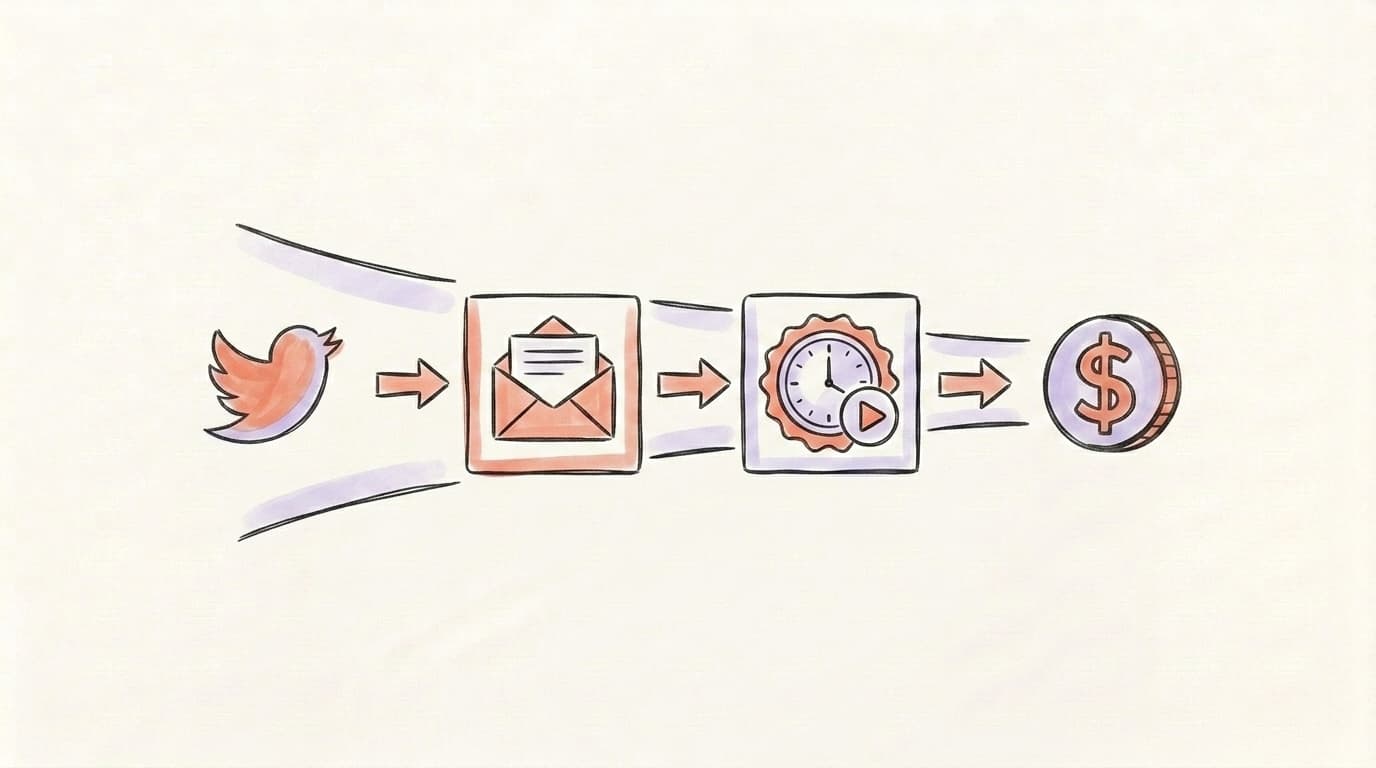
The X-to-paid funnel works as a slow handoff: X earns attention, email keeps it, the trial proves value, and the product converts — each stage warming the buyer before asking for anything. Almost nobody sees a tweet and buys. They follow you, watch for a few weeks, click your pinned tweet, join your email list, and then start a trial when the timing's right. Founders who treat X as a core channel report acquiring their first 100 customers purely through organic activity, but it takes a deliberate path. Your pinned tweet should state who you help and offer a low-friction next step (a free resource or the email list). Your bio should make the value obvious in one line. Email is where you go deeper than 280 characters and stay in front of people who aren't ready yet. The trial is where the product does the selling. The whole system runs on consistency — the founder who posts daily for months wins over the one who launches loudly once and disappears.
Here's a founder who built the entire thing in public on X — going from roughly $1K to over $13K MRR in a few months by sharing the journey:
His takeaway: the growth came from showing up daily and sharing wins and losses honestly, not from one perfect launch.
Start Growing on X with Postory
The hardest part of all this isn't the strategy — it's the consistency. Three pillars, daily replies, a steady drip of build-in-public posts, all in a voice that sounds like you and not a marketing team. Most founders quit not because the playbook is wrong, but because doing it by hand every day competes with actually building the product.
That's the gap Postory closes. It learns your founder voice from how you already write, so AI-drafted X posts read like you wrote them — Story, Insight, and Product posts that don't sound like marketing. You stay in control of the message; you just stop staring at a blank compose box every morning. And because the same posts can flow to Threads and Bluesky, your X distribution work pulls double duty across the platforms your buyers use.
Try Postory free — write SaaS-founder-voiced X posts that sound like you, not your marketing department.
For the deeper tactical layer, our build-in-public X playbook breaks down exactly what to share and when, and our guide on how to grow on Twitter covers the platform fundamentals every founder should know.
FAQ
Q: How long does it take to grow on Twitter as a SaaS founder?
Expect a slow first month while you find your rhythm — most founders see a few hundred new followers in month one and several hundred to a thousand across months two and three. Real compounding tends to kick in after the three-month mark, once you've found your voice and built a reply habit. Consistency matters far more than any single viral post.
Q: How many times a day should a founder post on X?
For an account under 1,000 followers, aim for 3-5 posts a day plus 20-30 replies. As you grow past 1K, you can scale posts and replies up. The replies often matter more than the posts early on, since they're how new people discover you.
Q: Should I build in public if my revenue is small or zero?
Yes. Small numbers are relatable and make great story hooks — "$0 to first paying customer" is more engaging than a polished revenue chart. Share ranges and milestones rather than exact bank balances, and lean on the lessons more than the figures. Building in public from zero is how many founders attract their first users.
Q: Do threads work better than single tweets for SaaS founders?
In our experience, threads generally earn more reach than single tweets because they hold attention longer, which tends to signal the algorithm to distribute them further. But keep them short — a focused thread of a handful of tweets beats a sprawling 15-tweet epic. Use threads for stories and frameworks; use single tweets for quick observations and product moments.
Q: Where should I put links in my tweets?
Put external links in the first reply, not the main tweet — though not because links are penalised. X's open-sourced ranking code has no hard-coded link penalty, the link click is a positively weighted action, and the only negatively weighted actions are not interested, mute author, block author, report and not dwelled. The real cost is where a link sends the reader: a reply or a repost, both weighted above a link click, only happen while they are still on X. A clean main tweet earns those first, and the "link below" reply still routes interested readers to your site or signup page.
Q: How do I turn Twitter followers into paying customers?
Treat it as a handoff: X earns attention, your email list keeps it, a free trial proves value, and the product converts. Use your pinned tweet and bio to offer a low-friction next step, then nurture people who aren't ready yet over email. Most buyers follow you for weeks before they ever start a trial.
Q: Can AI write my X posts without making them sound generic?
It depends on the tool. Generic AI writers produce recognizably fake, marketing-flavored copy. Tools built around your own voice and past posts — like Postory's AI post writing — draft in a way that sounds like you, which is the whole point for a founder whose authenticity is the asset.
Related articles
How I Got My First 100 Followers on X (From a Dead Account)
I started a brand new X account with zero followers and had my first 100 real followers a few days later. Here's the exact playbook.
Jul 19, 2026

The X Profile Banner Strategy: What to Put Above Your Tweets
Your X banner is prime real estate most accounts waste. 6 banner archetypes that turn profile visits into follows — plus the exact 2026 dimensions.
May 30, 2026
The X Quote Tweet Strategy That Outranks Replying
Quote tweets let you piggyback on bigger accounts' distribution while building your own. Here's the exact 5-format playbook that turns other people's reach into your followers in 2026.
May 29, 2026