Threads vs. LinkedIn: Which Should You Post On?

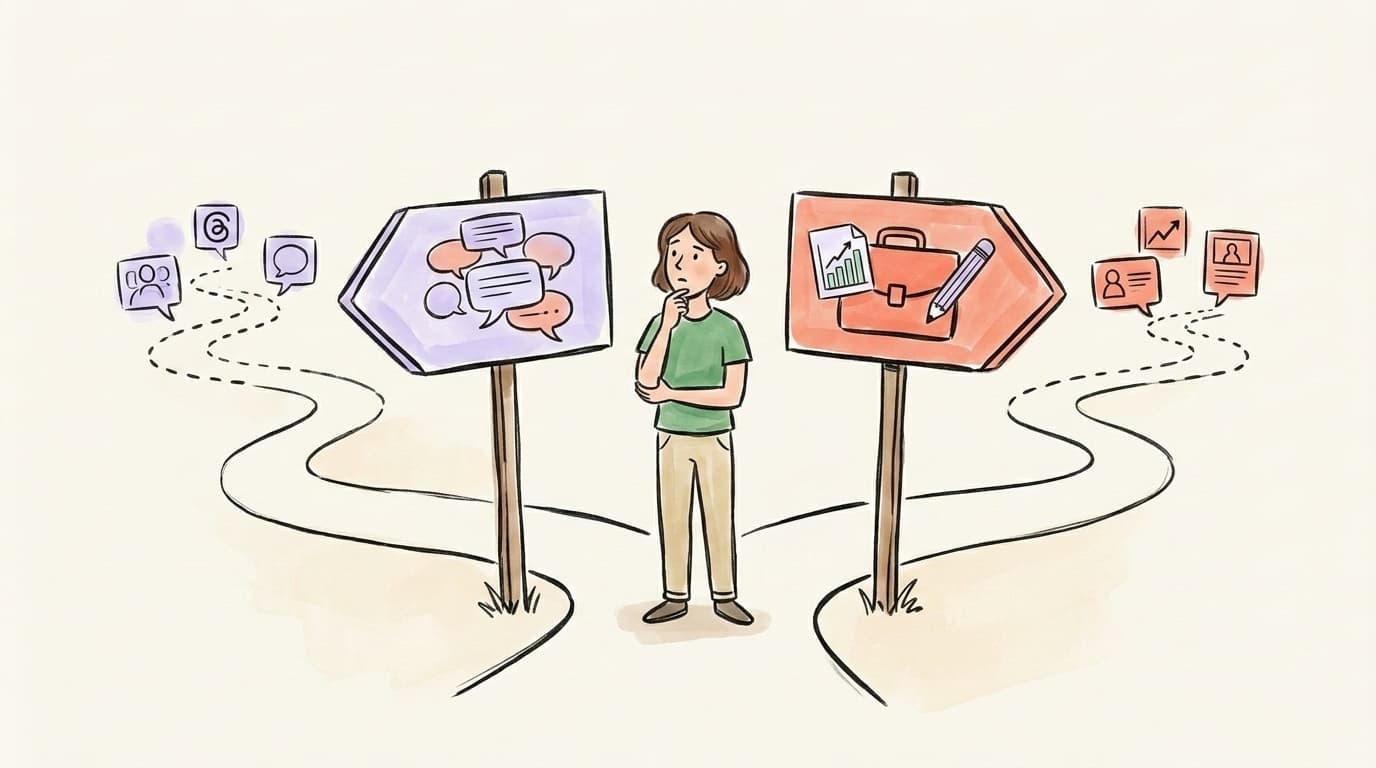
LinkedIn is where B2B buyers already are and where your content converts to pipeline — start there. Meta Threads is the cheaper place to test ideas, build reach fast, and find an audience that hasn't seen you yet. Most founders should anchor on LinkedIn and use Threads as the low-cost top-of-funnel.
You only have so many hours, and every "founder should be posting" article tells you to be everywhere. That's bad advice. The real question isn't "Threads or LinkedIn?" — it's "where are the people who can actually buy from me, and what's the cheapest way to reach them?" This post breaks down the audience, the content, the algorithms, the time cost, and a clear verdict by company stage.
Where Are Your B2B Buyers — On Threads or LinkedIn?
For B2B founders, LinkedIn is where the buyers already are and Threads is where you go to find people who don't know you yet. LinkedIn counts roughly 40 million decision-makers and 65 million worldwide who influence purchases, with 4 out of 5 members driving business decisions at their company. That density is the entire point — you're posting into a room full of buyers. Meta Threads reached 500 million monthly active users in June 2026 and now beats X on mobile daily users, but its audience skews consumer: 64% of B2C brands post on Threads versus just 19% of B2B brands. The takeaway for a founder is simple. If your goal this quarter is qualified pipeline, LinkedIn's buyer concentration wins. If your goal is cheap reach and audience-building before anyone's heard of you, Threads gets you in front of more new eyeballs faster.

How Do B2B Decision Makers Behave on Each Platform?
B2B decision makers treat the two platforms completely differently, and that changes what you should post. On LinkedIn, people show up in "work mode" — they're open to vendor content, case studies, and thought leadership, and 89% of B2B marketers use it for lead generation because the intent is already there. LinkedIn also reports its users carry twice the buying power of the average web audience, and the platform generates more B2B leads per impression than most other social channels. On Threads, the same people are in "scroll mode" — they're relaxed, conversational, and reacting to opinions, not evaluating vendors. That's not a weakness; it's a different job. Threads is where a founder builds familiarity and personality so that when a buyer later sees you on LinkedIn or lands on your site, you're already a known name. Use LinkedIn to convert intent. Use Threads to manufacture the recognition that makes that intent show up.
AI that learns your voice
Posts that actually sound like you
Postory's AI writes drafts in your voice — not generic AI mush — so you publish faster and still sound human.
Here's a sharp breakdown of how the LinkedIn game changed in 2026 — useful context before you decide how much to invest:
What Content Format Travels Well on Threads vs. LinkedIn?
The format that wins is different on each platform, so the same post rarely performs well in both places unchanged. LinkedIn rewards substance and dwell time — its 2026 algorithm measures how long people actually read, and posts that hold attention for 61+ seconds hit around 15.6% engagement versus 1.2% for skim-and-scroll posts. That's why document carousels (around 6.6% engagement) and longer text posts outperform link-heavy updates, which lose roughly 60% of their reach. Threads is the opposite: short, punchy, conversational. A single sharp observation, a hot take, or a question that invites replies travels further than a polished essay. The practical move is to write one founder note, then shape two versions — a longer, structured take for LinkedIn and a tight, opinionated one-liner for Threads. They're the same idea wearing different clothes, and trying to ship identical copy to both is the most common mistake founders make.
Which Algorithm Rewards Founder Voice More?
How Many Hours a Week Does Each Platform Cost?
Realistically, LinkedIn demands more effort per post but fewer posts, while Threads demands less per post but more frequency and replying. To get traction on LinkedIn, a founder typically needs three to five substantive posts a week plus comment engagement — call it three to five focused hours, because each post has to earn dwell time. Threads runs on volume and conversation: one to three short posts a day plus active replying, which can also land around three to five hours but split into many small bursts instead of deep work sessions. Neither is "free." The hidden cost on Threads is the reply habit Mosseri describes — growth there is a daily presence, not a publishing schedule. The hidden cost on LinkedIn is that mediocre content now gets buried, so the bar for quality is high. If you only have a few hours a week and want predictable business outcomes, concentrate them on LinkedIn. If you have small pockets of time throughout the day and want to build an audience cheaply, Threads fits the rhythm of your phone better.
When Does Cross-Posting From LinkedIn to Threads Actually Work?
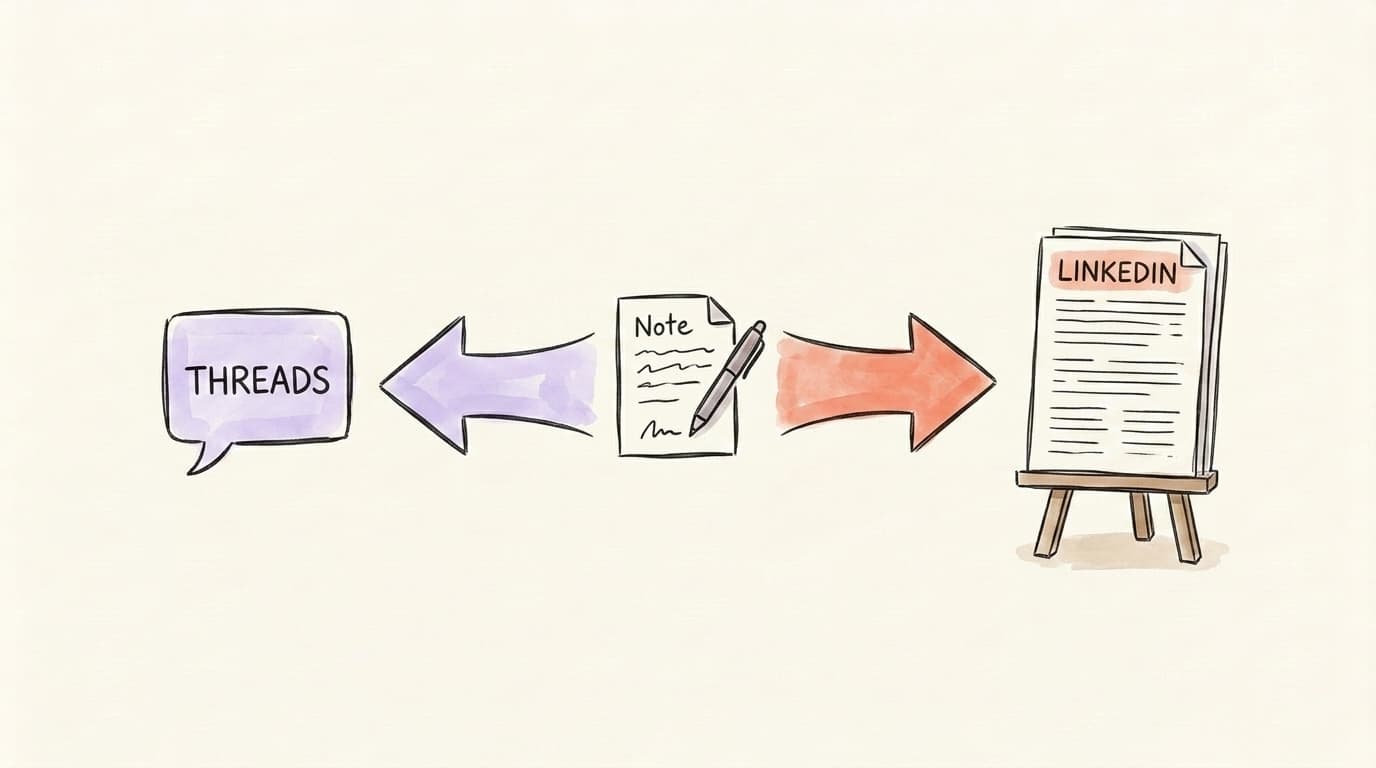
Cross-posting works when you treat LinkedIn as the source of ideas and Threads as the place to atomize them — not when you paste the same block of text into both. A long LinkedIn post usually contains three or four distinct ideas; each one can become a standalone Threads post that sparks its own conversation. The reverse also works: a Threads reply that got unexpected traction is often the seed of a fuller LinkedIn piece. What doesn't work is identical copy. LinkedIn formatting (line breaks, hooks, "see more" cliffhangers) reads stiff and corporate on Threads, and Threads brevity reads thin and unsubstantiated on LinkedIn. The smart workflow is one idea, two native versions. This is exactly the kind of repetitive reshaping that eats a founder's afternoon — and where a tool that rewrites a single note into platform-perfect versions saves the most time. The goal is reuse of thinking, not copy-paste of text.

Verdict: Threads or LinkedIn by Founder Stage?
The right answer depends entirely on your stage, so here's a clear call for each. There's no single winner — there's a winner for where you are right now.
Pre-Launch (No Product, No Audience)
Start with Threads. You have no buyers to convert yet, so the job is building reach and a personality cheaply. Threads' newcomer-friendly algorithm and reply-driven growth let a complete unknown gain traction in weeks, not quarters. Post daily, reply more than you post, and figure out which ideas resonate. Treat it as free market research with a built-in audience.
$0–100K MRR (Early Traction, Selling Now)
Anchor on LinkedIn, keep Threads as a side bet. You now have something to sell and need qualified pipeline, which means going where the buyers are. Post three to five substantive LinkedIn pieces a week, engage in comments, and turn your best LinkedIn ideas into Threads posts to keep building top-of-funnel awareness. LinkedIn drives revenue; Threads keeps the audience growing.
Scaling ($100K+ MRR, Team in Place)
Run both intentionally. At this stage you can afford the dual cadence — LinkedIn for authority, demand, and recruiting; Threads for reach, culture, and staying top-of-mind. The key is a system: one founder voice, repurposed natively across both, so you're not doubling the work. This is where most scaling founders break — they try to be everywhere manually and burn out. Build the workflow instead.
Start Posting Smarter With Postory
Here's the friction every founder hits: the thinking behind a great post takes ten minutes, but reshaping it into a LinkedIn-perfect version and a Threads-perfect version eats another thirty. That's the tax that makes founders give up on one platform.
Postory removes half of it. Write one founder note — a rough thought, a customer story, a hot take — and Postory's AI post writing turns it into Threads, X, and Bluesky versions in one click, each shaped for how that platform's algorithm and audience actually behave, then publishes them from one place. The LinkedIn version stays yours to write, but it's the only one that does.
If you want to go deeper on either platform, our guides on what to post on LinkedIn, using Threads for business, and Threads vs. Twitter cover the tactics in detail.
Try Postory free — turn one founder note into Threads, X, and Bluesky posts.
FAQ
Q: Is Meta Threads good for B2B founders?
Threads is good for B2B founders who want cheap reach and audience-building, less so for direct lead generation. Its audience skews consumer and only about 19% of B2B brands post there, but its newcomer-friendly algorithm makes it one of the fastest places to grow from zero. Use it as top-of-funnel awareness, not as your primary sales channel.
Q: Should a founder choose LinkedIn or Threads first?
If you're already selling, choose LinkedIn first — that's where B2B decision makers are and where content converts to pipeline. If you have no product or audience yet, start on Threads to build reach and personality cheaply, then layer LinkedIn in once you have something to sell. Stage decides the order.
Q: Can I post the same content on Threads and LinkedIn?
You can reuse the idea but you shouldn't paste identical text. LinkedIn rewards longer, substantive posts that earn dwell time, while Threads rewards short, conversational, reply-driven posts. The best approach is one note rewritten into two native versions.
Q: How many hours a week does LinkedIn take for a founder?
Plan for roughly three to five focused hours a week: three to five substantive posts plus time commenting and engaging. LinkedIn's 2026 algorithm rewards quality and dwell time, so each post needs real effort. Fewer, better posts beat daily filler.
Q: Does the Threads algorithm favor small accounts?
Yes. Threads reportedly delivers 8–12% reach for accounts under 10K followers and surfaces posts from accounts users don't follow, so a strong post can travel regardless of follower count. Replies are weighted heavily, so engaging in conversation is the fastest growth lever for a new account.
Q: What kind of content works best on LinkedIn for founders?
Document carousels and substantive text posts perform best because they hold attention — LinkedIn's algorithm prioritizes dwell time, and posts read for 60+ seconds see dramatically higher engagement. Avoid link-heavy posts, which lose significant reach. Share specific lessons, customer stories, and contrarian takes tied to your expertise.
Q: Is Threads bigger than X now?
Threads reached 500 million monthly active users in June 2026, per Meta, and surpassed X in mobile daily active users in early 2026, according to Sprout Social. For founders that means a large, growing, engaged audience — though one that's still more consumer-oriented than LinkedIn's professional base.
Related articles
How to Batch Create Social Media Content (No Burnout)
Batch content creation turns the daily panic into one calm session that funds two weeks of posts. Here's the exact workflow.
Apr 17, 2026

Threads vs X (Twitter) 2026: Which Is Better for Creators?
Threads vs Twitter/X in 2026 — audience, algorithm, monetization, ads, account safety, tools, and the cross-posting workflow creators actually use.
Aug 15, 2026
The 20 Best Hook Formulas for X, LinkedIn, and Threads
20 copy-paste hook formulas that stop the scroll on X, LinkedIn, and Threads — plus how to tune each one per platform.
Jun 16, 2026