

Threads for Solopreneurs: Grow in 1 Hour a Week

Spend 30 minutes capturing ideas, 20 minutes batch-writing on Friday, and 10 minutes scheduling Monday-Friday slots. That's a full week of Threads in one hour — no daily grind, no burnout.
You don't have time to live on Threads. You have a product to ship, clients to serve, and a hundred other things competing for your attention. The good news: you don't need to be online all day to grow on Threads. You need a system. This post gives you a 1-hour-per-week workflow for how to post on Threads consistently, build a personal brand, and turn attention into email subscribers — without it eating your life.
Why Does Threads Beat X for Most Solopreneurs Right Now?
For most solopreneurs in 2026, Threads is the better bet than X because the platform is still in its growth phase, the algorithm favors individual voices over big brand accounts, and reach is far easier to earn from a standing start. As of January 7, 2026, Threads had 141.5 million daily active mobile users versus X's 125 million, and Threads grew 127.8% year-over-year in mobile usage as of mid-2025 while X declined. That divergence matters for you: a growing platform with weaker competition is exactly where a small account can punch above its weight. On Threads, content shared from personal accounts is currently seeing dramatically more organic reach than posts from corporate brand accounts — the algorithm rewards human, conversational voices. For a one-person business, that's a structural advantage you won't find on a mature, pay-to-play network.
The other reason is tone. Threads rewards personality over polish. Over-produced, salesy content tends to underperform, while authentic, conversational posts win. For the current picture of which formats land, see what works on Threads in 2026. That's perfect for a solopreneur — you don't need a design team or a video studio. You need opinions, stories, and a willingness to talk like a human.
What Is the 1-Hour/Week Threads System?
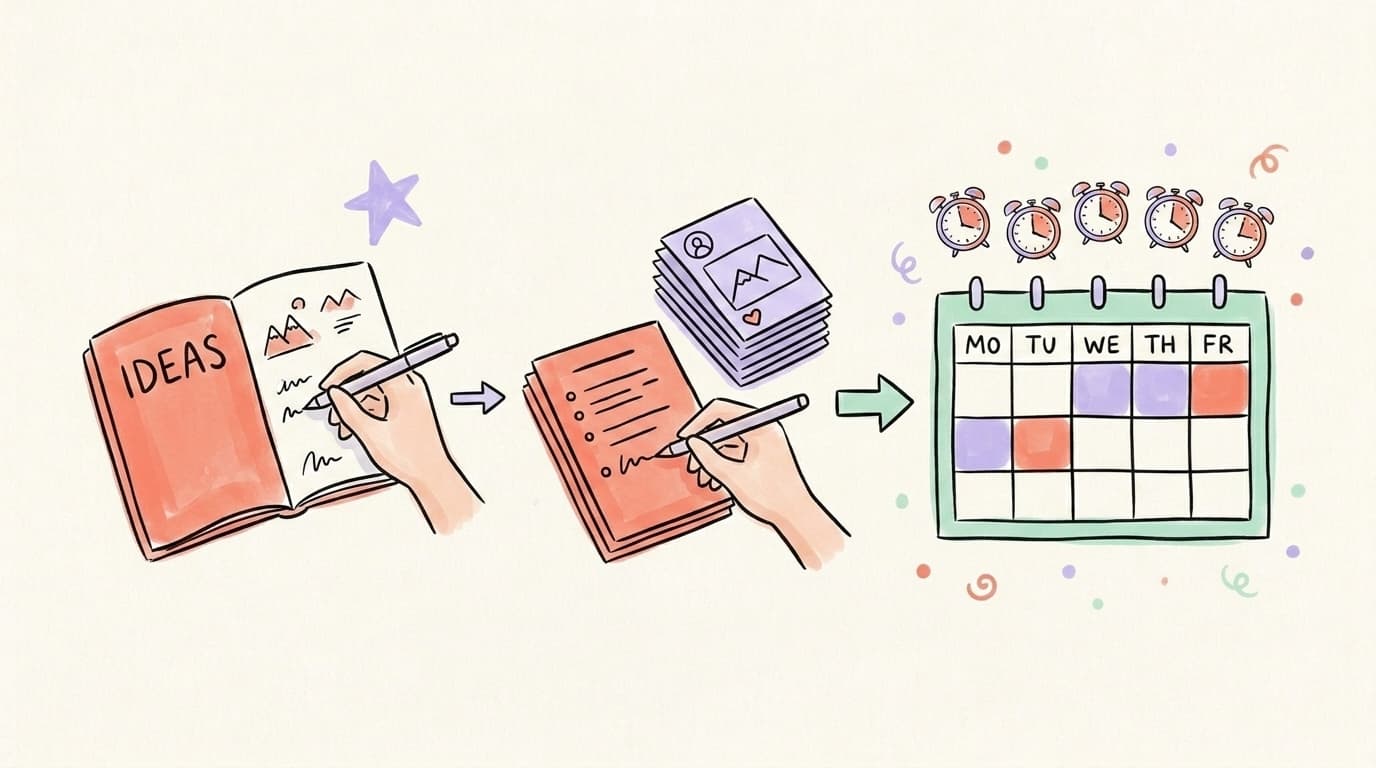
The 1-hour/week Threads system is a batched workflow that splits your weekly Threads work into three small, repeatable blocks: 30 minutes of idea capture spread across the week, 20 minutes of focused batch writing on Friday, and 10 minutes of scheduling for Monday-Friday slots. The whole point is to stop treating Threads like a daily chore and start treating it like a production line. You're not "checking Threads" five times a day. You're capturing ideas as they happen, writing them all in one sitting, and queuing them up to post on autopilot. This is the same logic behind batch-creating social media content — context-switching is the silent killer of solo productivity, and batching kills the switching cost. One hour, one platform, one week of presence. The three blocks total roughly 60 minutes, but you never spend more than 20 of them in deep-focus mode, which is what keeps it sustainable week after week.
Content calendar
Plan a month of content in an afternoon
Map out your posts on a visual calendar, batch your ideas, and never stare at a blank page again.
Here's the weekly breakdown at a glance:
- 30 min — Idea capture: Jot down post ideas as they hit you during the week (no writing yet).
- 20 min — Batch write: Friday, turn 5 of those ideas into 5 finished posts.
- 10 min — Schedule: Drop them into Monday-Friday slots and forget about it.
The trick is that none of these blocks require deep focus at the same time. Capture is passive. Writing is the only real work. Scheduling is mechanical. Split them up and the whole thing fits in the cracks of a busy week.
Step 1: How Do You Capture Ideas in 30 Minutes a Week?
You capture ideas by setting up daily triggers — small recurring moments that prompt you to write down a post idea — rather than trying to brainstorm from a blank page once a week. The 30 minutes isn't one block; it's spread across the week in tiny bursts. Every time you answer a client question, read something that annoys you, learn a lesson the hard way, or have a strong opinion in a conversation, you drop a one-line note into your phone. That's it. You're not writing posts yet — you're collecting raw material. By Friday you'll have 10-15 fragments to choose from, which is more than enough to write 5 good posts. The reason this works is that the hardest part of posting on Threads isn't writing, it's deciding what to say. Daily triggers solve the "what do I post" problem before you ever sit down to write.
Set up three or four reliable triggers:
- The client question. Every question a customer asks is a post. If one person asked, dozens are wondering.
- The strong opinion. Caught yourself disagreeing with a take online? Write the counter-take down.
- The behind-the-scenes moment. A win, a mistake, a small lesson from running your business that week.
- The save. Anything you bookmark, screenshot, or send to a friend is a signal you have something to say.
Keep all of these in one place — your notes app, a single doc, or a planner. The format doesn't matter. Lowering the friction does. The goal is that capturing an idea takes five seconds, so you actually do it.
Step 2: How Do You Batch-Write Threads Posts in 20 Minutes?
You batch-write by setting a 20-minute timer on Friday, pulling up your idea list, and turning five fragments into five finished posts back-to-back — without editing, polishing, or second-guessing between them. The reason this is fast is that you've already done the thinking during the week. Now you're just translating notes into Threads-ready language. Aim for four minutes per post: write the hook, add one or two supporting lines, end with a question or a takeaway. Threads is forgiving and conversational, so you don't need to be perfect — you need to be human. Resist the urge to overwrite. The posts that perform best are short, specific, and sound like you talking, not like a press release. If a post takes longer than four minutes, move on; an unfinished idea is a future post, not a Friday problem.
A simple template that works for most solopreneur posts:
- Hook (line 1): A bold claim, a question, or a surprising fact.
- Body (1-2 lines): The lesson, story, or proof behind the hook.
- Close (line 1): A question to spark replies, or a clear takeaway.
Short video and text posts tend to perform best on Threads, with images close behind, so if a screenshot or simple graphic fits, add it — but it isn't required. But don't let image-hunting slow your batch. Text-first is fine. If you're staring at a blank screen, AI post writing can turn a one-line idea into a draft in your voice that you tweak in seconds, which keeps your 20 minutes on track.
Here's a useful walkthrough of growing a Threads presence as a solo creator, including how the engagement loop actually works:
Step 3: How Do You Schedule a Week of Threads in 10 Minutes?
You schedule by taking your five finished posts and dropping one into each weekday slot — Monday through Friday — using a planner or scheduling tool, then closing the tab and not thinking about Threads again until next Friday. This is the mechanical block; it requires zero creativity. Most creators see solid results posting one to three times per day on Threads, but for a solopreneur running a 1-hour system, one quality post per weekday is a sustainable, defensible cadence that still keeps you visible. Spread posts across your peak windows and space them out so each one gets its own attention rather than competing with the next. The magic of scheduling is psychological as much as practical: once the week is queued, Threads stops being a nagging open loop in your head. You've shown up for the whole week in ten minutes.
A few scheduling rules that keep the system healthy:
- One post per weekday. Five posts, five slots. Don't dump them all on Monday.
- Hit your peak windows. Check your Threads insights for when your audience is active and aim there.
- Leave room to react. The schedule covers your baseline. You can still hop on live for replies or a timely take when it's easy.
Postory's social media planner lets you see your whole week on a calendar and queue Threads posts into the slots you choose — so the 10-minute scheduling block becomes drag, drop, done. The system runs even on the weeks you're slammed.
How Do You Build a Threads → Email Funnel for Your Product?
You build a Threads-to-email funnel by treating Threads as the top of the funnel (attention), a free resource as the bridge (the email opt-in), and your product as the destination — and by mentioning the free resource naturally in your posts rather than hard-selling. Threads sends the social traffic; email is where you actually own the relationship and make offers. The flow looks like this: someone reads a helpful post, clicks your profile link to grab a free guide or checklist, joins your list, and then hears from you regularly — including when you launch. Because Threads lets you add links and the algorithm rewards genuinely useful content, solopreneurs can drive real signups without being spammy. The key is that 80% of your posts give value freely, and a small slice point to your free resource. Sell the list, not the post.
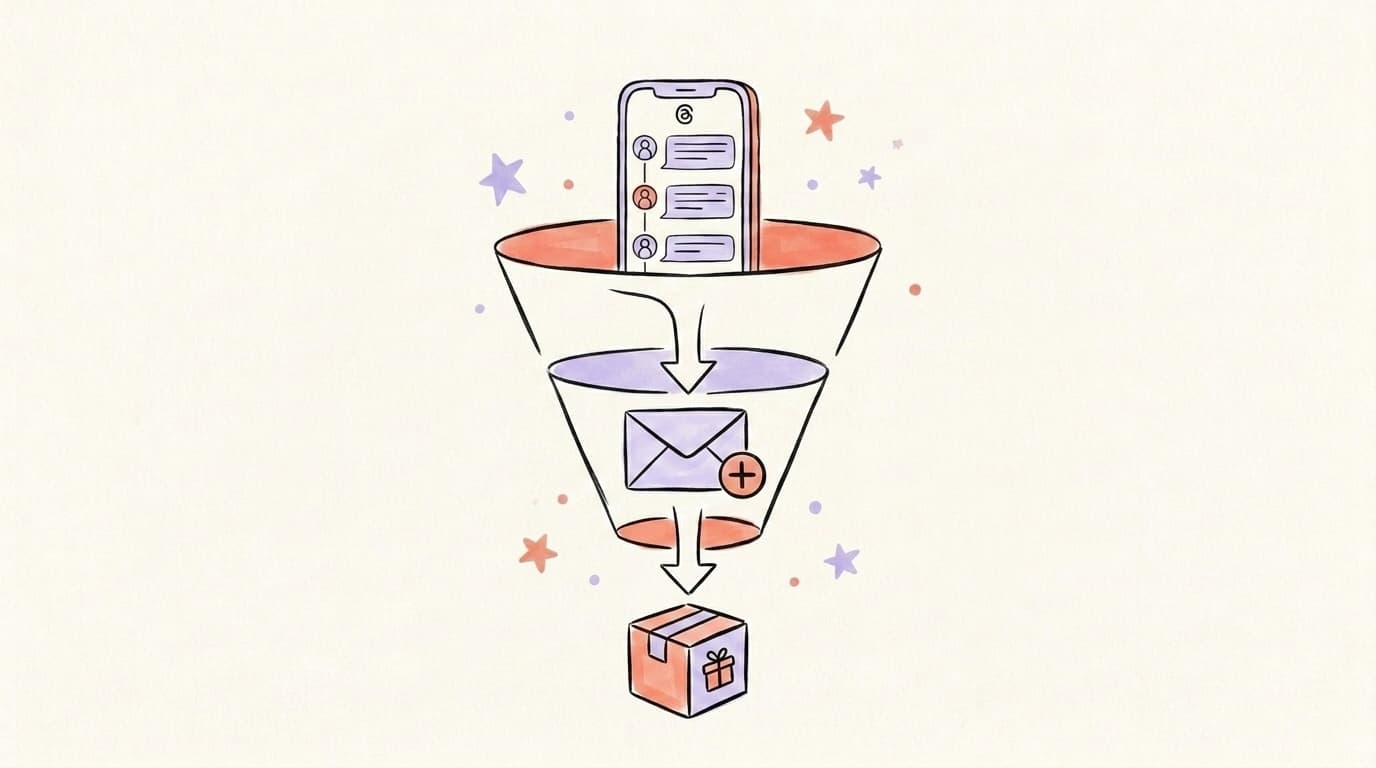
To make the funnel work without extra weekly effort, build it into the batch:
- Pick one lead magnet. A short PDF, a template, a mini-checklist — something a follower would happily trade an email for.
- Put the link in your bio. Make it the obvious next step from your profile.
- Reference it naturally. In roughly one of every five batched posts, mention the free resource as a logical extension of the topic ("I put the full checklist in my free guide — link in bio").
- Let email do the selling. Your product pitches live in your email sequence, not in your feed.
This is also where a personal brand on social media compounds: the more consistently you show up with a clear point of view, the more your free resource and your eventual product feel like the obvious next step rather than a sales pitch.
How Do You Avoid Burnout on a New Platform?
You avoid burnout by capping your involvement to the system, refusing to chase daily virality, and detaching your mood from any single post's performance. Burnout on a new platform almost always comes from doing too much, too inconsistently, while staring at metrics that swing wildly day to day. The 1-hour system is itself the main defense: when your week is batched and scheduled, you're not pulled back into the app a dozen times a day, and you're not improvising posts at 11pm. Beyond the system, the mindset shift matters most. Threads is a long game — most posts will be quiet, a few will pop, and that's normal for everyone, including big accounts. Judge yourself on whether you ran the system this week, not on whether a post went viral. Consistency over a quarter beats intensity over a weekend, every time.
A few guardrails that keep the platform sustainable:
- Cap your time. One hour for production, plus optional light engagement. Set a timer if you have to.
- Don't refresh for dopamine. Check insights once a week when you batch, not every hour.
- Reuse what works. If a post lands, that's a topic to revisit — not a one-off you have to top.
The goal isn't to win Threads this week. It's to still be posting in six months, when the compounding actually shows up.
Start Posting on Threads with Postory
Knowing how to post on Threads is one thing; doing it every week without it becoming a job is another. That's exactly the gap a planner closes. Once you've batched your five posts on Friday, Postory's social media planner turns this into a recurring weekly workflow you don't have to think about — a calendar where you queue your Threads posts into Monday-Friday slots and let them go out automatically. Pair it with AI post writing to draft posts in your voice during your 20-minute block, and the whole hour gets even lighter.
Try Postory free — plan and queue a full week of Threads posts in one sitting, then let it run.
FAQ
Q: How do I post on Threads as a beginner?
Open the Threads app, tap the compose button, and write a short post — text, an image, or both. Threads rewards conversational, natural-language writing over polished marketing copy, so write the way you'd talk to a customer. Start with one post per weekday and build from there.
Q: How often should a solopreneur post on Threads?
One post per weekday is a sustainable baseline that keeps you visible without burning out. Most creators see good results in the one-to-three-posts-per-day range, but for a 1-hour-per-week system, five quality posts spread Monday to Friday is plenty. Consistency matters more than raw volume.
Q: Is Threads better than X for building a personal brand?
For most solopreneurs in 2026, yes. Threads is in a growth phase, its algorithm currently favors individual voices over brand accounts, and it recently passed X in daily mobile active users. Less competition and easier organic reach make it the better starting point for a one-person business.
Q: What should I post on Threads to grow a personal brand?
Post things only you can say: lessons from running your business, answers to client questions, strong opinions in your niche, and behind-the-scenes moments. Authentic, conversational content outperforms over-produced posts on Threads — within the platform's own limits, which are worth knowing before you push one (what Threads does and doesn't allow). A clear point of view is what makes content easy to produce — see how to build a personal brand around one so you never run out of material.
Q: Can I schedule Threads posts in advance?
Yes. Using a planner like Postory, you can write a batch of posts and queue them into specific weekday slots so they publish automatically. Scheduling is what makes the 1-hour-per-week system possible — you do the work once and stay present all week.
Q: How do I turn Threads followers into customers?
Build a simple funnel: offer a free lead magnet (a guide, template, or checklist) with the link in your bio, mention it naturally in roughly one of every five posts, and let your email list do the selling. Threads drives the attention; email owns the relationship and makes the offers.
Q: How long does it take to grow on Threads?
Treat it as a long game measured in months, not days. Most posts will be quiet and a few will pop — that's normal for accounts of every size. The compounding from consistent, batched posting usually shows up over a quarter, which is exactly why a sustainable 1-hour system beats short bursts of intense effort.
Related articles
Build in Public on X: The Founder's Playbook
A practical build-in-public playbook for solo founders: cadence, content types, what to keep private, and how to recut updates for X, LinkedIn, and Threads.
May 24, 2026
Threads Posting Frequency: How Often Is Too Often?
The honest, data-backed answer to how often you should post on Threads — by stage, by niche, and built so you don't burn out.
May 22, 2026
Bluesky vs Mastodon vs Threads vs X: The Honest 2026 Comparison
Bluesky vs Mastodon vs Threads vs X in 2026 — audience size, engagement and moderation compared, plus which two are actually worth your time.
May 22, 2026