
How to Increase X/Twitter Impressions Without Buying Ads

Find out which habit is capping your impressions
An instant audit of your handle: when you post, how often, what you post about and how you reply — scored, with the fix that moves reach the most on top.
Impressions are how many times your posts show up on screens. To grow them without ads, write for early engagement velocity, reply more than you post, keep links out of the main tweet, and track what's working per platform.
Chasing followers is backwards. Followers are a lagging result — impressions are the leading signal. More impressions means more profile visits, more follows, and more of everything you actually want, which is why anyone trying to grow on Twitter should start here.
The good news: X's distribution is mostly earned, not bought. You don't need an ad budget to get seen. You need to understand what the algorithm rewards and post accordingly.
What Counts as an "Impression" on X in 2026?
An impression on X is counted every single time one of your posts is rendered on someone's screen — in their For You feed, their Following feed, your profile, search results, or inside a quote post. One person can generate several impressions for the same post if they scroll past it more than once or see it on different surfaces. Impressions are not unique people, and they're not engagement. They're raw exposure: how many times your content had a chance to be seen. This is the same metric we covered for LinkedIn in our guide to LinkedIn impressions — the definition is nearly identical across platforms. On X, your impression count is the top-line number in the analytics panel under any post, and it's the number every other metric ultimately depends on, because nothing else can happen until a post is actually rendered in front of a human.

Impressions vs. Engagements vs. Profile Visits — What's the Difference?
These three metrics sit in a funnel, and confusing them is the most common reason people misread their own analytics. Impressions are the top of the funnel — every time your post appears on a screen. Engagements are the middle — likes, replies, reposts, bookmarks, and quote posts, the actions people take after seeing it. Profile visits are closer to the bottom — when someone is interested enough to tap your name and check you out, which is where follows actually happen. A post can rack up huge impressions with weak engagement (a sign the content didn't land), or modest impressions with strong engagement (a sign it resonated but didn't get distribution). You want both, but they move for different reasons. Impressions are driven by the algorithm's distribution decisions; engagement is driven by how good the post is once it's seen.
Why engagement is the lever, not the goal
Engagement drives impressions, not the other way around — that's the loop. According to a 2026 breakdown of the X algorithm, different actions carry wildly different weights — a like is the baseline, a repost is worth roughly 20x a like, a reply about 27x, and a full conversation where the author replies back can be worth around 150x a like. So the path to more impressions runs through engagement, especially the high-value kind. Get replies and conversations, and the algorithm hands you more reach.
Profile analysis
See how your profile really scores
Postory analyzes your X, Threads or Bluesky profile and shows exactly what to fix to get more reach. Audits run on credits, bought in packs.
The 10 Tactics That Move Impressions
Here are the tactics that actually shift your impression count, ordered roughly by impact. None of them cost money — they cost attention and consistency.
One caveat first: these all assume your posts are actually being distributed. If your reach didn't just plateau but collapsed suddenly across every post, rule out a shadowban before you optimize anything — no tactic can fix reach that X is quietly filtering. If that free shadowban test comes back flagged, a paid X shadowban recovery scan goes deeper than any free tester: search ban, search suggestion ban, ghost ban and reply deboost are probed on live data and read as one verdict, and it returns a prioritized plan for lifting the restriction.
- Earn early engagement velocity. Multiple 2026 analyses point to the first 30 to 60 minutes as the strongest distribution signal. A post that gets replies and reposts fast outperforms one that earns the same engagement spread over a day. Post when your audience is awake and prime it with a reply or two.
- Reply more than you post. Replies let a small account borrow attention from conversations that already have it. A person who posts 3 times and replies 30 times will usually outgrow someone who posts 10 times and never engages.
- Keep links out of the main post. External links pull users off-platform, and X heavily suppresses their reach. Put your link in the first reply instead, not the original tweet.
- Open with a hook. Lead with a bold opinion, a number, a question, or a clean first line. Don't bury the point — the first sentence decides whether anyone reads the second.
- Use native video. Even a 60-second clip tends to out-reach a text-only post. X wants to keep people watching, so it rewards video that holds attention.
- Tell stories, not just tips. Advice-only feeds plateau. Personal stories and real moments consistently outperform generic how-to posts because people connect with people.
- Post consistently. Distribution compounds. Showing up daily teaches the algorithm — and your audience — to expect you.
- Write for replies, not likes. End posts with something worth responding to. A reply is worth far more to your reach than a passive like.
- Stay positive and constructive. Wider distribution tends to go to content that isn't purely negative or rage-bait. The algorithm increasingly filters for it.
- Don't overthink every post. Forced posts feel forced, and they underperform. Your fastest, most natural takes often travel the furthest.

How Do Posting Time and Frequency Affect Impressions?
Posting time and frequency still matter, but less than they used to. In the older system, the first 30 minutes after posting essentially decided a post's fate, so timing was everything. Under X's 2026 AI-driven ranking, posts can keep getting picked up and distributed for up to 24 hours based on the content itself — which means a post that looks dead at first can take off hours later. Creator Jacob C. Edmunds describes exactly this shift in his algorithm walkthrough: posts now "keep getting pushed for about 24 hours" rather than dying after the first half hour. The practical takeaway: post when your audience is active to seed early engagement, but don't obsess over the perfect minute. Frequency still helps — posting daily keeps you in rotation — but flooding the feed with low-effort posts can split your own engagement and dilute each one's reach.
Here's Jacob's full breakdown of what changed and what's working now:
Do Threads (Multi-Post Chains) Get More Impressions?
Threads can multiply impressions, but only when they're tight. The mechanic is simple: each post in a chain is its own object that can surface in feeds, so a strong thread gives the algorithm more entry points into your content and more surfaces to distribute. But the era of the 15-post epic thread is over — long chains lose readers fast, and a reader who drops off at post three never sees the rest. The 2026 sweet spot most creators land on is short, punchy chains of roughly 3 to 6 posts with a clear hook up front and a payoff that earns the scroll. If you're writing threads, structure them like a single argument broken into beats, not a brain-dump. The first post has to stand alone and earn the click into the rest. For more on how X's ranking treats chained content, see our deeper X algorithm guide.
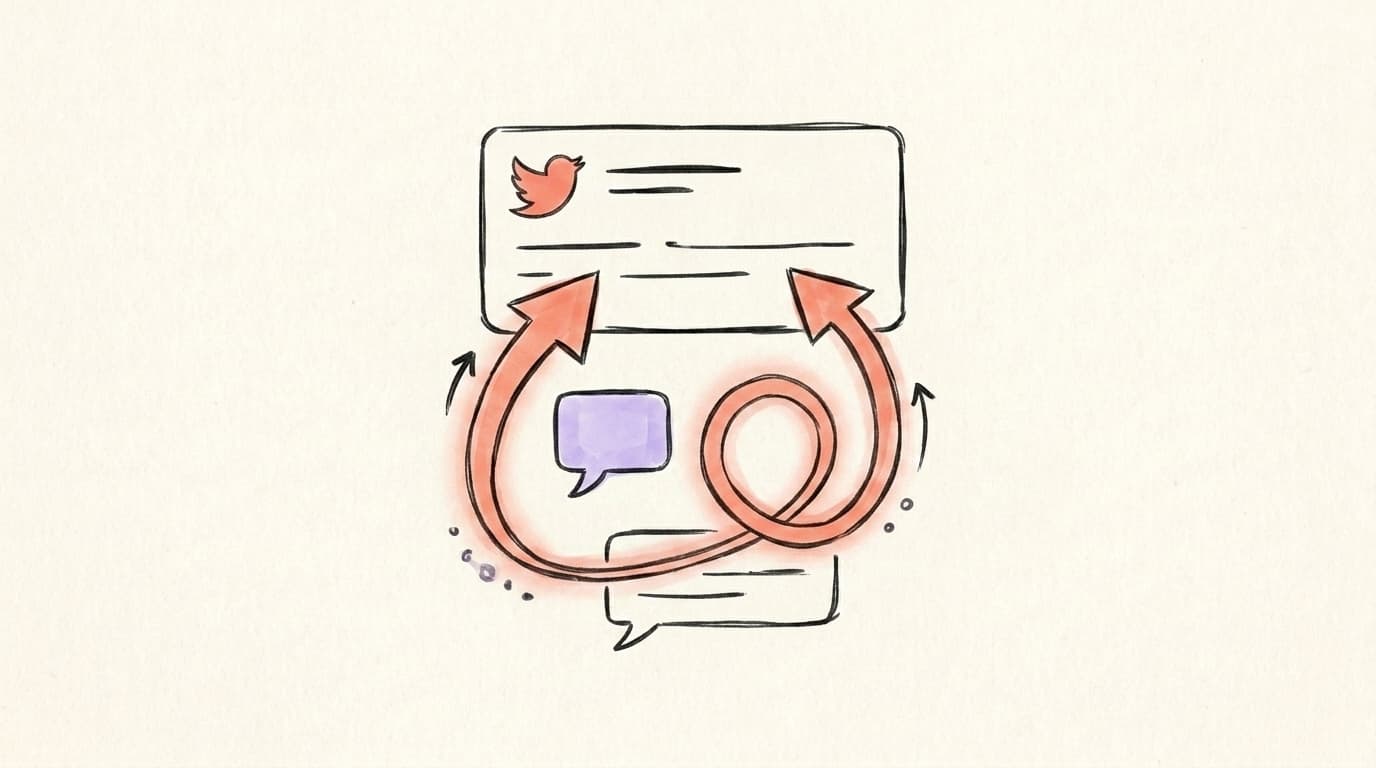
Why Do Replies Boost Impressions on Your Original Post?
Replies boost your original post because of how X weights conversations. A reply isn't just a metric — when someone replies and you reply back, you create a conversation, which the algorithm treats as one of the strongest possible engagement signals. As the same 2026 algorithm breakdown notes, a reply carries roughly 27 times the weight of a like, and a full author-reader conversation can be worth around 150 times a like. That means actively replying to the people who comment on your post doesn't just feel polite — it feeds a high-value signal straight back into the post's distribution, which can push it to more screens. The implication is direct: don't post and walk away. Stick around for the first hour, reply to early comments, ask follow-up questions, and turn one-off likes into back-and-forth conversations. Each reply you send on your own post is a vote for more impressions.
How Do You Track Impressions Over Time?
Tracking impressions over time is how you tell the difference between a lucky post and a repeatable pattern. A single viral post tells you almost nothing — what matters is the trend across dozens of posts and the answer to "what do my best posts have in common?" X's native analytics show per-post impressions, but they don't connect the dots into a strategy or compare performance across platforms. That's the gap Postory's social media analyzer fills. It grades your X, Threads, or Bluesky profile out of 100 across consistency, content mix, profile, and timing — using your real reach and engagement data to surface which posting times earn the most views and where your cadence is slipping. Instead of staring at raw impression numbers, you get ranked fixes and a clear read on what's actually moving your reach.
Start Growing on X with Postory
Knowing how to grow on Twitter is one thing — doing it consistently is the hard part. The tactics above only work if you show up, post regularly, and pay attention to what lands.
That's where Postory helps. The social media analyzer scores your profile and tells you exactly which fixes will move your reach, so you're not guessing. And once you know what works, Postory's AI post writing helps you turn ideas into posts that sound like you — fast enough that you actually keep posting.
Try Postory free — analyze your X profile, find what's dragging your reach down, and grow your impressions without ever buying an ad.
FAQ
Q: How many impressions is good on X?
There's no universal number — it depends entirely on your follower count and niche. A better measure is your engagement rate (engagements divided by impressions) and whether your impressions are trending up over time. Compare yourself to your own past posts, not to giant accounts.
Q: Why are my X impressions suddenly dropping?
Common causes include posting external links in the main tweet, a drop in posting consistency, content that isn't earning early engagement, or simply a quieter period for your niche. Check whether your recent posts got replies in the first hour — weak early engagement is the usual culprit. If the drop was sudden and steep across every post, run a free Twitter shadowban test to rule out search-ban or reply-deboost filtering before you blame your content — and if it comes back positive, here's how to fix it.
Q: Do impressions count if someone scrolls past without stopping?
Yes. An impression is counted whenever your post is rendered on screen, whether the person reads it, engages, or scrolls right past. That's why impressions measure exposure, not interest — you need engagement metrics to gauge whether people actually cared.
Q: Does X Premium increase impressions?
Premium gives posts some algorithmic priority and lets you post longer content and reply higher in threads, which can help reach. But it won't rescue weak content — distribution still ultimately depends on whether your posts earn engagement.
Q: Are impressions the same as views on X?
Effectively yes. X displays a "Views" count on each post, which is the public-facing label for impressions — the number of times the post was seen. The analytics panel breaks this down further by surface (feed, profile, search).
Q: How long does a post keep gaining impressions?
Under X's 2026 ranking, posts can keep getting distributed for up to roughly 24 hours, not just the first 30 minutes. After about a day, even strong posts get minimal additional push as time decay takes over.
Q: Can I grow impressions without posting more often?
Yes — replying is often more effective than posting. Spending your time replying thoughtfully in active conversations can drive more impressions to your account than publishing extra original posts that nobody sees.
Related articles

How to See Your Impressions on X (Twitter)
How to see impressions on X: the per-post panel, the account dashboard, and what X does not document — checked against X's own sources.
Sep 9, 2026
How to See Who Unfollowed You on X (X Won't Tell You)
How to see who unfollowed you on Twitter: X sends no alert and keeps no history, so here's the snapshot method trackers run on — and how to run it yourself.
Sep 8, 2026
X/Twitter Engagement Rate: How to Calculate It, What's Good
Your Twitter engagement rate is engagements divided by impressions — or by followers. The formula, both denominators, and what benchmarks say is good.
Sep 8, 2026