
Do Hashtags Still Work on X (Twitter) in 2026?

Check what else is throttling your reach
Hashtags are rarely the whole story. The audit grades the habits that move reach most — when you post, how often, what about, how you reply — and ranks what to fix first.
On X in 2026, hashtags no longer help the algorithm understand your post, and stacking them can flag your post as spam. Use one — at most — only for live events or branded campaigns. For everything else, skip them. If you want to learn how to grow on Twitter, the answer is better content, not more tags.
Hashtags were literally invented on Twitter in 2007. Almost two decades later, the platform's own owner is telling you to stop using them. That's not a style note — it reflects a real change in how X decides what gets seen.
So here's the honest answer to whether hashtags still belong in your posts, backed by what the algorithm actually does and the handful of cases where a tag still earns its place.
Do Hashtags Still Work on X in 2026?
Mostly no. On X in 2026, hashtags have almost no positive effect on reach, and using several can actively hurt you by tripping the platform's spam detection. The algorithm no longer relies on hashtags to figure out what your post is about — it reads the actual text with an AI model. In December 2024, Elon Musk posted, "Please stop using hashtags. The system doesn't need them anymore and they look ugly," as reported by FOX 5 DC. Even X's own help guidance recommends a maximum of two hashtags per post, and creators widely report that more than that looks spammy. So if you're learning how to grow on Twitter, drop the reflex to tag everything. A clean post with strong writing beats a post crusted with #marketing #growth #contentcreator every time. Hashtags aren't forbidden — they're just no longer a growth lever.
Why Did X Turn Against the Hashtag?
X turned against hashtags because the feature solved a problem the platform no longer has. Hashtags existed so the old system could group posts by topic — back when computers couldn't really "read" a tweet. They were a manual workaround for weak machine understanding. Today, X uses an AI-powered ranking system — xAI's open-sourced recommendation code ports its ranker from a Grok transformer — that reads the words, watches the video, and understands the topic on its own. The hashtag is a vestigial organ. On top of the technical reason, there's a cultural one: dense hashtag stacks read as low-effort or bot-like to both the system and your followers. When the platform's leadership publicly calls them "ugly," that signals an aesthetic and product direction, not just a personal preference. The result is a feed where the cleanest, most readable posts tend to look the most native — and tag-heavy posts increasingly look out of place.

AI that learns your voice
Posts that actually sound like you
Postory's AI writes drafts in your voice — not generic AI mush — so you publish faster and still sound human.
How Does the Algorithm Treat Hashtags Today?
Today the X algorithm treats hashtags as neutral-to-negative text, not as a reach signal. After xAI released its Grok-based open-sourced X recommendation algorithm in 2026, independent breakdowns describe a system that scores posts on direct engagement and content quality rather than keyword or hashtag matching. Replies, reposts, and bookmarks carry far more weight than a like, while negative actions like blocks, mutes, and "show less" carry heavy penalties, per a detailed source-code analysis. Crucially, that same analysis notes that stacking hashtags can trip the spam classifier — which is the opposite of what you want. The takeaway: the model decides who sees your post based on what the post says and how people react to it. A hashtag adds no topical understanding the AI doesn't already have, so at best it's wasted characters and at worst it nudges you toward a spam flag.
Here's a clear walkthrough of how the post-2025 X algorithm actually evaluates content, from a creator who tested the changes on his own account:
When Do Hashtags Still Help on X?
Hashtags still help on X in three specific situations where a tag functions as a clickable destination rather than a reach hack. First, live events and conferences: when thousands of people tweet the same official tag (think a conference's #Event2026 or an awards-show tag), that tag becomes a real-time gathering point people actively click and search. Second, branded campaigns and community tags: a unique hashtag you own (a product launch, a recurring series, a community label) lets people find and follow the conversation — its value is grouping, not algorithmic boost. Third, breaking news and trends: jumping into an already-trending tag can put you in front of people browsing that topic in the moment. Notice the pattern — in every case the hashtag is a navigation tool people deliberately use, not a magic reach multiplier. Outside these three, a hashtag does little. Use one, keep it specific, and only when there's a genuine destination behind it.
What Hashtag Mistakes Tank Your Reach?
The biggest hashtag mistakes tank reach by making your post look like spam or by burying your message. The clearest offenders are easy to spot and easy to fix. Stacking three, four, or five tags is the single most common error — the open-source algorithm analysis notes that going past two hashtags trips the spam classifier and can cut reach by roughly 40%, while one or two niche-relevant tags is the practical ceiling. Generic mega-tags like #love or #follow attract bots and bring zero relevant audience. And leading with a hashtag buries your actual hook below a blue link before anyone reads a word. Picture a post that opens with "#startup #founder #saas #buildinpublic" — by the time a reader's eye reaches your sentence, you've already signaled "promotional" and spent your most valuable real estate on tags the AI ignores. Here are the mistakes worth cutting:
- Hashtag stacking — using 3+ tags signals spam to the classifier.
- Generic vanity tags — #viral, #fyp, and #follow attract bots, not readers.
- Hashtag-as-sentence — writing "this #startup #founder #journey" makes copy hard to read.
- Opening with a hashtag — your first words should hook, not categorize.
- Recycling the same tag everywhere — repetitive tagging looks automated.
Fix all five and most posts read cleaner and perform at least as well — usually better, because you've removed the spam triggers.
Topic Tags vs. Hashtags: Why Does the Difference Matter?
The difference matters because X increasingly relies on AI-driven topic understanding that works whether or not you add a hashtag. A hashtag is a literal string you type with a # in front of it. A topic, by contrast, is what the algorithm infers from your words — the semantic subject of the post. In the modern system, the topic is what governs distribution: the AI reads "I just shipped a new feature for my SaaS" and routes it toward people interested in software and startups, no #SaaS required. This is why the old advice to "tag your niche" is obsolete. You don't tag your niche anymore; you write your niche, clearly, in plain language, and the model handles classification. Practically, that means your energy is better spent on a sharp first line, a clear subject, and specific keywords used naturally in the sentence — not on appending tags. The hashtag describes; the content decides.
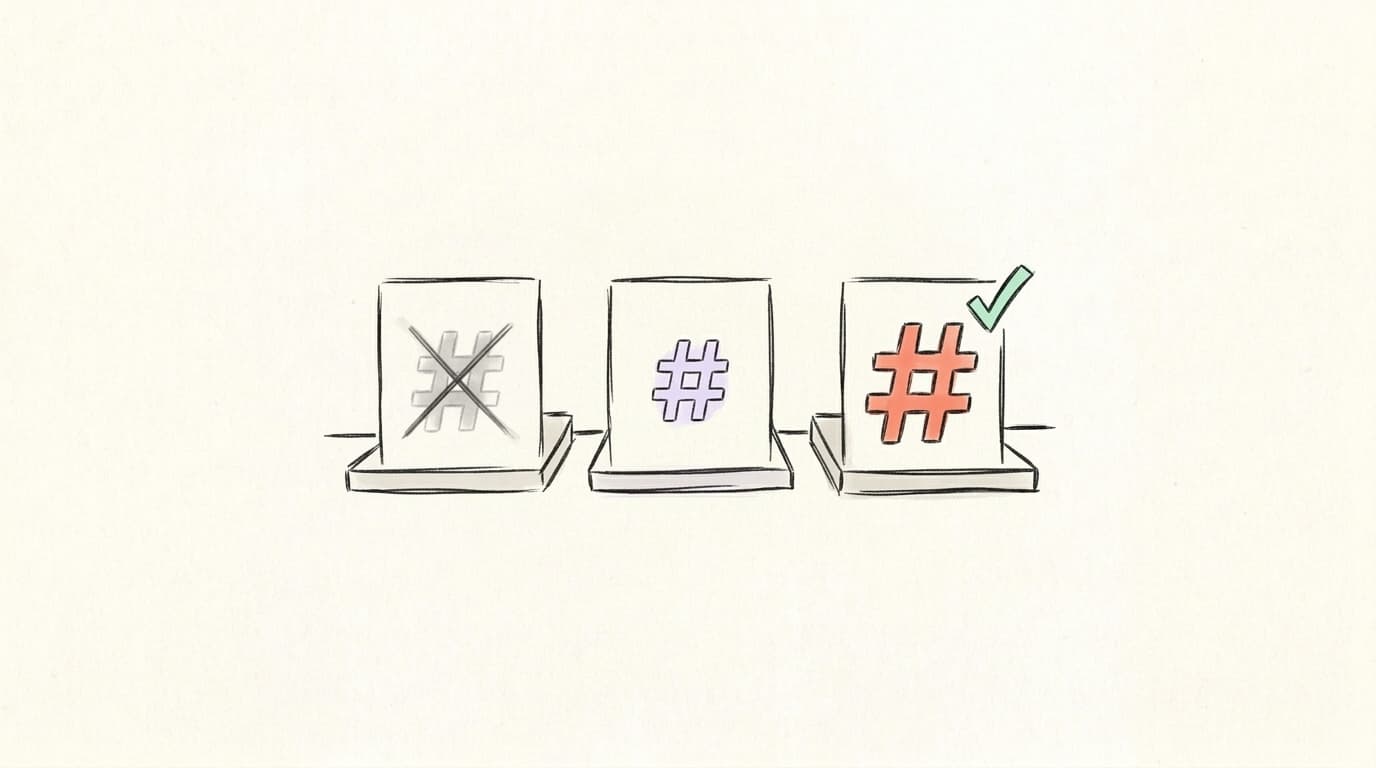
How Do Hashtags Compare on X vs. Threads vs. LinkedIn?
Hashtags behave differently on each platform, so a single habit won't serve you across all three. On X, they're mostly inert and risky in bulk — skip them outside events and campaigns. On Threads, the model is intentionally minimalist: you can attach only one topic tag per post, people can't follow tags, and Adam Mosseri has been clear that tags help categorize and surface posts in search rather than directly boost reach. (We cover this fully in our guide to Threads hashtags.) On LinkedIn, hashtags still function as topic labels and search aids, but they're supporting signals, not growth hacks — and overloading a post with them can dilute reach, so a small handful of specific tags is the norm. The throughline across all three: hashtags are for discovery and grouping, not for gaming distribution. Match the platform's rules — one tag on Threads, a few targeted ones on LinkedIn, near-zero on X — and lead with strong content everywhere.
| Platform | Hashtag role in 2026 | Practical advice |
|---|---|---|
| X / Twitter | Near-zero reach value; bulk use risks spam flag | 0–1, only for events/campaigns |
| Threads | One tag max; aids search, not reach | 1 specific topic tag |
| Topic label + search aid; supporting signal | A few targeted tags |
What Should You Do Instead to Grow on X?
Instead of relying on hashtags, you should grow on X by feeding the signals the algorithm actually rewards: engagement and clear, native content. Since the system reads your post directly and weighs replies, reposts, and bookmarks far above likes, your job is to write posts people respond to and save. That means a strong first line that earns the next line, a specific point instead of a vague one, and a reason for someone to reply or bookmark. Native media helps too — many creators report that adding an image or video lifts impressions noticeably. Consistency compounds: posting regularly and replying thoughtfully in your niche builds the account-quality and relationship signals the model factors in. For the full mechanics of what gets rewarded and penalized, see our breakdown of the X/Twitter algorithm. None of this involves a hashtag. The growth lever in 2026 is the post itself.
Start Writing Better X Posts with Postory
The short version: stop optimizing for hashtags and start optimizing for the post. That's harder to do consistently — which is exactly where a tool helps.
Postory generates X posts that follow current best practices — including when to skip the hashtag entirely. Its voice-trained AI post writing turns a raw idea, article, or video into a clean, native-feeling post in your own voice, so you spend your energy on the hook and the point instead of decorating posts with tags that no longer work.
Try Postory free — write X posts that read clean, sound like you, and skip the spammy hashtag stacks.
FAQ
Q: Do hashtags hurt your reach on X in 2026?
A single relevant hashtag won't hurt you, but stacking three or more can. A source-code analysis of X's open-sourced algorithm reports that going past two hashtags trips the spam classifier, and X's own guidance recommends keeping it to two at most. The safest approach is zero to one.
Q: How many hashtags should I use on a tweet?
Zero in most cases. If there's a genuine reason — a live event, a branded campaign, or a trending topic you're joining — use one specific hashtag. The old "3–5 hashtags" advice no longer applies on X.
Q: Why does Elon Musk say to stop using hashtags?
In December 2024 he posted that the system doesn't need them anymore and that they "look ugly." X's AI-based ranking reads your post content directly to understand the topic, so hashtags no longer help with classification or discovery the way they once did.
Q: Do hashtags help small accounts grow on X?
Not meaningfully. The algorithm distributes posts based on content quality and engagement, not hashtags. Small accounts grow faster by writing reply-worthy posts, adding native media, and engaging consistently in their niche than by adding tags.
Q: Are topic tags the same as hashtags?
No. A hashtag is the literal #word you type. A topic is what the algorithm infers from your actual words. On modern X, the topic — derived by AI from your text — drives distribution, which is why writing your subject clearly matters more than tagging it.
Q: Should I use hashtags on Threads and LinkedIn instead?
Use them differently. Threads allows one topic tag per post and treats it as a search/categorization aid, not a reach booster. LinkedIn still uses hashtags as topic labels, where a few targeted tags help discovery — but they're supporting signals, not growth hacks.
Q: What actually grows a Twitter account in 2026?
Consistent, clear, native posts that earn replies, reposts, and bookmarks — plus regular engagement in your niche. The algorithm rewards content people react to, so the highest-leverage move is improving the post itself, not adding hashtags.
Related articles

How to Host an X Space in 2026: Requirements, Setup, Step by Step
Everything you need to host an X Space in 2026 — account requirements, the exact setup steps, and how to get listeners to show up.
May 23, 2026

X Bio Ideas: 30 Examples + the Formula That Gets Follows (2026)
30 X bio ideas you can copy, plus the 160-character formula behind them — what to keep, what to cut, and how to test it.
May 22, 2026

Twitter/X Algorithm 2026: What xAI's Open-Sourced Code Shows
xAI's biggest algorithm drop landed on May 15, 2026 — the full For You stack. Here's what it says about growing on X, straight from the Rust and Python files.
May 16, 2026