
The 20 Best Hook Formulas for X, LinkedIn, and Threads

A hook is the first line that earns the second. Here are 20 proven formulas — story, data, contrarian, and curiosity — plus how to write LinkedIn posts, tweets, and Threads so the hook lands inside each platform's preview cutoff.
Your post can be brilliant and still die in the feed. If the first line doesn't stop the thumb, nobody reads the rest. That's the whole game.
This is a swipe file. Below are 20 hook formulas grouped by type, real examples for each, and a section on how to write LinkedIn posts, tweets, and Threads so the hook fires before the "see more" cut. Steal them all.
What Does a Hook Actually Do? (Stop the Scroll)
A hook is the first line of your post — the one job it has is to earn the second line. Readers decide in a second or two whether your content is worth their time, and most scroll past if nothing grabs them. A good hook is a pattern interrupt: it jolts the reader out of autopilot with curiosity, tension, or a claim they can't ignore. It doesn't sell, summarize, or warm up — it creates an open loop the reader has to close. The reliable mechanism is curiosity plus specificity plus relevance: emotion makes them feel something, a concrete number makes it believable, and tension makes them need the next line. A vague opener like "Some thoughts on growth" gets ignored every time, while "I analyzed 500 viral posts and the pattern was obvious" pulls the reader in. Nail the first line and the rest of your post finally gets a chance to work.
The 20 Hook Formulas at a Glance
Here are all 20 formulas in one list so you can scan and grab. Each one is a fill-in-the-blank template — swap in your topic and ship it. They're grouped into four families: story hooks open a narrative loop, data hooks lead with a hard number, contrarian hooks pick a fight with common wisdom, and curiosity hooks dangle a gap the reader has to close. The best creators rotate across all four so their feed never feels repetitive, and the same core idea can be reframed through any of them — a single insight about pricing can become a confession, a shocking stat, an unpopular opinion, or an open loop depending on which family you reach for. You don't need to memorize them — bookmark this, and the next time you're staring at a blank post box, pick a family that fits your idea and fill in the blank.
- The confession
- The before/after
- The turning point
- The "I used to believe"
- The failure lesson
- The day-in-the-life cliffhanger
- The conversation opener
- The shocking stat
- The comparison number
- The "I analyzed X"
- The cost reveal
- The timeline
- The benchmark gap
- The "everyone's wrong"
- The unpopular opinion
- The "stop doing X"
- The sacred-cow takedown
- The open loop
- The numbered promise
- The "nobody talks about"

AI that learns your voice
Posts that actually sound like you
Postory's AI writes drafts in your voice — not generic AI mush — so you publish faster and still sound human.
What Are Story Hooks? (Formulas 1–7)
Story hooks work because the human brain can't leave a narrative unfinished — open a loop and the reader has to close it. These seven formulas drop the reader into the middle of a moment, a change, or a tension that demands resolution. They outperform on LinkedIn and Threads, where personal, human framing earns trust and longer dwell time. The key is to start in scene, not with setup: skip "I want to share a story about..." and open at the dramatic point. For example, "The day I got fired I had $40,000 in savings and no plan" works because it's already mid-conflict. Pair a specific detail (a real number, a real place, a real quote) with an unresolved tension, and the reader keeps going to find out what happened. Vague stories die; specific ones travel.
- The confession — "I've never told anyone this, but..." Opens with vulnerability that demands you keep reading.
- The before/after — "Two years ago I was [low point]. Today I [result]. Here's what changed."
- The turning point — "Everything changed the moment I [decision/event]."
- The "I used to believe" — "I used to believe [common idea]. Then [event] proved me wrong."
- The failure lesson — "I lost [thing] doing [mistake]. Here's the lesson that cost me [amount]."
- The day-in-the-life cliffhanger — "It was 6 a.m. and I was already crying at my desk."
- The conversation opener — "My mentor said one sentence that changed how I work: '...'"
Why Do Data Hooks Work? (Formulas 8–13)
Data hooks lead with a hard number because specificity reads as credibility — a concrete figure feels true in a way a generic claim never does. These six formulas put a stat, a count, or a measurable result in the very first line, which is exactly why they perform on X (formerly Twitter), where viral posts consistently feature specific numbers and data points (posteverywhere, 2026). "I grew from 500 to 50,000 followers in 6 months" outperforms "I grew my following fast" because the reader can picture the math. The trick is to use your real numbers — invented stats get caught and torch your credibility — and to make the number slightly surprising or counterintuitive so it functions as a pattern interrupt, not just a fact. Round numbers feel made up; oddly specific ones ($2,140, 47 experiments, 11 days) feel real. Lead with the figure, then promise to explain how you got it.
- The shocking stat — "[Surprising %] of [group] do [thing]. Almost nobody talks about why."
- The comparison number — "[Option A] cost me $2,000/mo. [Option B] cost $0 and worked better."
- The "I analyzed X" — "I analyzed 500 viral posts. One pattern showed up every time."
- The cost reveal — "This mistake cost me $14,000. Don't repeat it."
- The timeline — "I went from 0 to 10,000 followers in 90 days. Here's the exact week-by-week."
- The benchmark gap — "Average [metric] is [X]. Mine is [Y]. Here's the difference."
When Should You Use a Contrarian Hook? (Formulas 14–17)
Contrarian hooks pick a fight with common wisdom, and that tension is what makes them spread — disagreement generates replies, and a comment section gives you something to answer that a row of likes doesn't. These four formulas stake out a position most of your audience assumes is settled, then promise to defend it. "Most growth advice is wrong — here's what actually works" invites both the people who agree (they'll amplify) and the people who don't (they'll argue), and both grow your reach. The one rule: you have to actually believe the take and back it up in the body, or you're just rage-baiting, which burns trust fast. Aim the contrarian energy at an idea or a practice, never at a group of people. Done right, a contrarian hook turns passive scrollers into a comment section — which is the thing you actually wanted.
- The "everyone's wrong" — "Everyone tells you to [common advice]. It's killing your results."
- The unpopular opinion — "Unpopular opinion: [thing most people praise] is overrated."
- The "stop doing X" — "Stop [common practice]. It's quietly wrecking your [outcome]."
- The sacred-cow takedown — "[Widely worshipped tactic] doesn't work anymore. Here's what replaced it."
What Are Curiosity Hooks? (Formulas 18–20)
Curiosity hooks open a gap between what the reader knows and what they want to know, and the brain treats that gap like an itch it has to scratch. These three formulas promise specific value or tease a secret without giving it away in the first line. "Nobody talks about this, but it doubled my reach" works because it names a payoff and withholds the method — the only way to get it is to keep reading. The danger is the empty tease: if your hook promises a revelation and the body delivers a shrug, you train your audience to scroll past you next time. So the rule is simple — only open a loop you actually close. Numbered promises ("7 tools that replaced $2,000/mo of software") are the most reliable curiosity hook because the number sets a clear expectation and the reader stays to collect all of it.
- The open loop — "I changed one thing last month and my reach doubled. It wasn't what you'd guess."
- The numbered promise — "7 free tools that replaced $2,000/mo of software for my business."
- The "nobody talks about" — "Nobody talks about this, but it's the real reason [outcome] happens."
How Do You Tune a Hook for Each Platform?
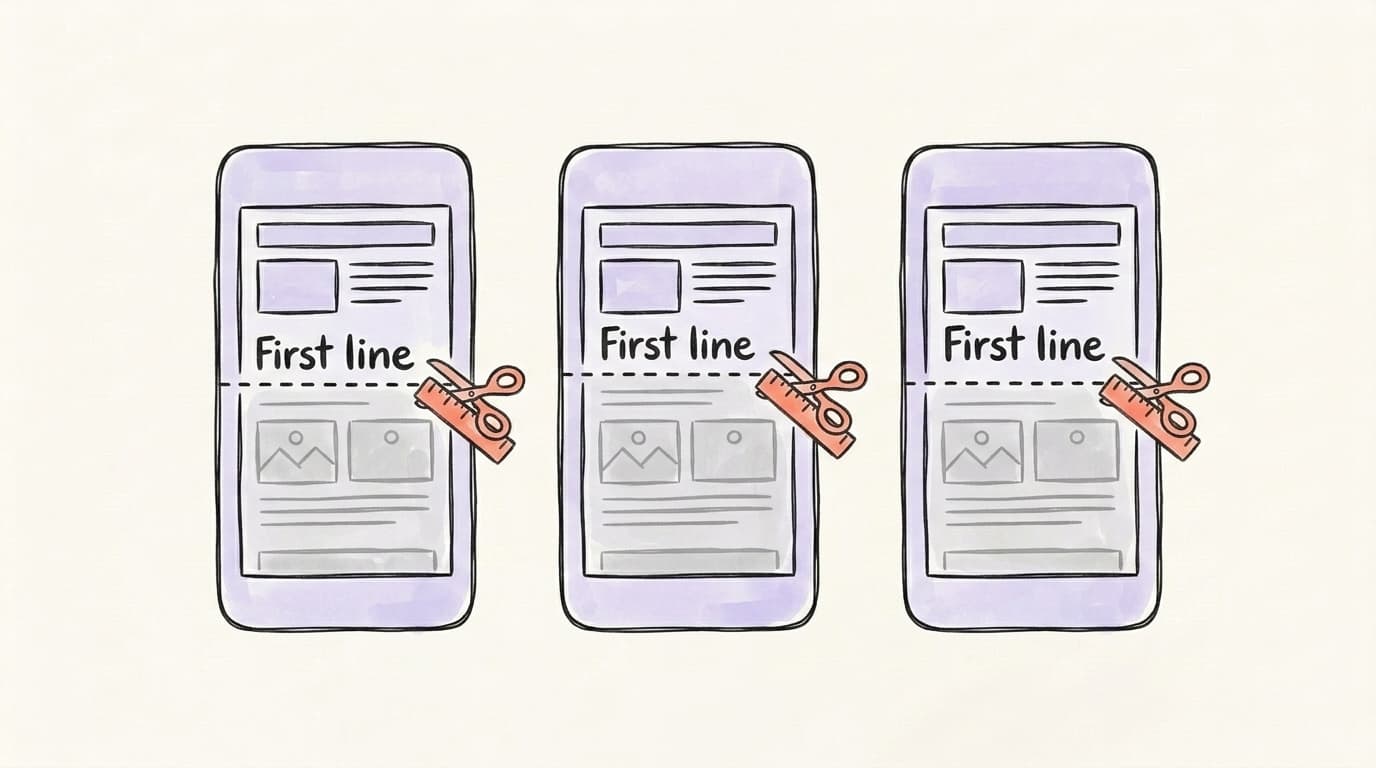
You tune a hook by writing it to land inside each platform's preview cutoff — the point where the feed truncates your post with "see more." Get the hook out before the cut, or readers never see it. On X, a single tweet is capped at 280 characters, and in a thread the first tweet is the whole hook — there's no truncation to beat, so front-load the boldest line and treat the opener as a standalone ad for the thread. On LinkedIn, posts truncate at roughly 210 characters on desktop and about 140 on mobile (AuthoredUp, 2026), so your hook has to fire inside the first line or two — and since most readers are on mobile, write to the 140-character cut. On Threads, only the first few lines show before "more" in the feed, so in practice the first sentence is your entire pitch.
The practical move on all three: write your hook as a complete, self-contained line, then delete everything before the most interesting word. If your draft opens with "I want to share something I learned about growth," cut straight to "Growth advice lied to you." Same idea, half the characters, twice the pull.
LinkedIn creator Pierre Herubel breaks down exactly why most first lines fail and how to fix them:
A few platform-specific notes worth keeping:
- X: Lead with the number or the claim. Avoid "thread 🧵" preambles — let the hook do the work. Replies within the first few minutes carry weight, so a hook that invites disagreement compounds.
- LinkedIn: Use a hard line break after the hook so it sits alone above the "see more." White space is part of the hook on LinkedIn.
- Threads: Conversational beats polished. A blunt first sentence ("This nearly killed my launch") outperforms a buttoned-up one.
Start Writing Better Hooks with Postory
Hooks are a skill — but staring at a blank box every morning is what actually kills consistency. That's the part to automate.
Postory is voice-trained: it learns how you write, then drafts posts that sound like you, not like a robot. Drop in an idea, a YouTube video, or an article, and it generates platform-ready posts for X, Threads, and Bluesky — each with a hook tuned to that platform's preview cutoff. (Postory doesn't publish to LinkedIn, so LinkedIn drafts stay yours to post.) You pick the hook you like, tweak the line, and ship it.
The formulas above give you the patterns. Postory gives you a draft in your voice in under a minute, so you're editing instead of staring. Want to repurpose one idea into all three platforms at once? That's exactly what it's built for.
Try Postory free — generate hooks in your voice, pick one, and ship it.
FAQ
Q: How do I write a hook for a LinkedIn post?
Write your hook as a single self-contained line and make sure it lands inside the first ~140 characters, since that's roughly where LinkedIn truncates on mobile (AuthoredUp, 2026). Lead with curiosity, a contrarian take, or a specific number, then add a hard line break so the hook sits alone above "see more." For a full breakdown, see our guide on what to post on LinkedIn.
Q: What makes a tweet go viral?
Viral tweets almost always share a strong first line: a specific number, a contrarian take, or a curiosity gap. Threads compound that effect because each tweet in the chain gives someone a new place to reply. See real breakdowns in our viral tweets guide.
Q: How long should a hook be?
Short enough to read in one glance. On X you have 280 characters but the hook should be one punchy line; on LinkedIn aim for the first ~140 characters; on Threads, one strong first sentence before the two-to-three-line cut. The shorter and more specific, the better it travels.
Q: Which hook formula works best?
There's no single best — rotate across story, data, contrarian, and curiosity so your feed never feels repetitive. Data hooks tend to win on X, story and contrarian hooks on LinkedIn and Threads. Test a few and double down on whichever drives the most replies for your audience.
Q: How do I come up with tweet ideas?
Mine three sources: questions your audience actually asks, things you're learning in public day to day, and moments from your own backstory. Each one maps cleanly onto a hook formula above. Capture them as you go so you're never starting from a blank box.
Q: Are hook formulas just clickbait?
No — clickbait promises something the post doesn't deliver. A good hook opens a loop your body actually closes. The rule is simple: only tease a payoff you genuinely provide, or you train your audience to scroll past you next time.
Q: Can AI write hooks that sound like me?
Yes, if it's trained on your voice rather than spitting out generic templates. Postory's voice-trained AI learns your style and drafts hooks that read like you wrote them, so you're editing a real first line instead of starting from scratch.
Related articles

Threads vs. LinkedIn: Which Should You Post On?
Threads vs. LinkedIn, answered: LinkedIn reaches buyers and converts, Threads builds reach faster and cheaper. Which one wins depends on one thing — here it is.
May 21, 2026
Threads Bio Ideas: 30 Examples That Hook Your Profile Visitor
Threads gives you 150 characters for your bio — same as Instagram. Here are 30 examples from growing accounts, plus a 5-element framework.
May 16, 2026
Canva Social Media Scheduler: What It Does, What It Costs, Limits
Canva's social media scheduler, reviewed: which platforms it posts to, what the free plan allows, and where it stops being enough.
Apr 24, 2026