Does Threads Allow NSFW or Nudity? Adult Content Rules

No, Threads does not allow adult content. It follows Meta's unified Community Standards — the same rules as Instagram — which prohibit nudity, sexual activity, and most sexually suggestive content. Enforcement is automated, fast, and stricter than X but identical to Instagram and Facebook.
If you've spent any time on Threads, you've probably tapped a post and seen the dreaded "Content Not Available" message. Or you've wondered why the platform feels so much tamer than X. Most articles handwave the policy. This one walks through exactly what's allowed, what's not, and why posts disappear — so you can post on Threads without tripping the enforcement system.
The Short Answer (And Why It's Complicated)
Does Threads allow adult content? No. Threads runs on Meta's unified Community Standards, which means the same rules that apply to Instagram and Facebook apply here. Nudity, sexual activity, and most sexually suggestive content are removed on sight by automated systems — usually before a human ever sees them. There is no "adult content" toggle on Threads the way there is on X or Bluesky. There is no monetization program for explicit creators. There is no "label as sensitive" workflow that lets you publish nudity behind a content warning. The platform simply isn't built to host that category, and Meta has been explicit since launch that Threads is positioned for advertisers and family-safe distribution, not adult creators. If your account leans NSFW even occasionally, Threads is going to be a constant fight with the classifier.
The complicated part is that "adult content" is not a single category in Meta's policy. The rulebook draws lines between explicit nudity, sexually suggestive content, art and breastfeeding exceptions, and commercial promotion of adult services. Each line is enforced differently. That's why one creator's lingerie photo gets removed and another's mastectomy-awareness post stays up — same body, different policy bucket.
What Does Threads' Official Content Policy Say?
Threads is governed by Meta's Community Standards, the same single rulebook that covers Instagram, Facebook, and Messenger. In November 2024, Meta consolidated what used to be separate Community Guidelines per app into one set of rules — so when you read "Instagram's nudity policy," you're also reading the Threads policy. The rules themselves did not loosen during that consolidation; they just got centralized into the unified Community Standards document. That matters for two reasons. First, a violation on Threads now counts against your standing on Instagram and vice versa — they share the enforcement backend, not just the rulebook. Second, when Meta updates the rules, the change applies to all four apps at the same time, so there's no "Threads-only" policy carve-out coming for adult creators. Treat the Threads rulebook as the Instagram rulebook with a text-first interface on top.
Under the Adult Nudity and Sexual Activity policy, Meta removes images and videos that show sexual intercourse, visible genitals, close-ups of fully nude buttocks, and most photos of female nipples. That removal applies whether the content is a photograph, an illustration, a digital edit, or AI-generated. The policy also covers sexually explicit language and sexual solicitation — DMing strangers for hookups is a removable offense even without an image attached. On top of that, Meta's age-appropriate content rules layer extra restrictions for users under 18, who don't see "sexually suggestive" content even when the policy would let an adult view it.
What Counts as "Sexually Suggestive" on Threads?
"Sexually suggestive" is the bucket that catches most creators by surprise. It's not nudity, but it's content the system treats as adult-adjacent — and on Threads, that's often enough to get a post hidden, suppressed, or removed without notice. Examples Meta gives include near-nudity covered by a digital overlay or strategic crop, suggestive poses where genitals or breasts are the focal point, lingerie shots that emphasize the body sexually rather than the product, and text that describes sexual acts in explicit detail. None of these show explicit anatomy, but all of them get filtered by Meta's classifiers as soon as they're posted. Posts in this bucket often don't get a removal notice — they just stop showing up in the For You feed, which is functionally the same as being deleted on a discovery-driven platform like Threads where reach depends almost entirely on the recommendation algorithm.
Profile analysis
See how your profile really scores
Postory analyzes your X, Threads or Bluesky profile and shows exactly what to fix to get more reach. Audits run on credits, bought in packs.
The line between "fitness content" and "sexually suggestive" is where most everyday accounts get tripped up. A workout video at the gym is fine. The same video shot from a low angle with a tight crop on the body can land in the suggestive bucket. Meta's automated systems don't read intent — they read framing, cropping, and pose.
What stays allowed: breastfeeding photos, post-mastectomy scarring, gender-affirming content, nudity in art with clear artistic context, and educational or medical content. These are explicit exceptions written into Meta's policy, and they're the categories most often restored on appeal when the automated system removes them by mistake.
Why Are You Seeing "Content Not Available" on Threads?
The "Content Not Available" message is Threads' catch-all error, and it shows up for at least three completely different reasons — which is why so many users assume the platform is buggy when it's actually behaving as designed. Understanding which of the three is happening tells you whether to retry, switch accounts, or just move on. Most of the time the cause has nothing to do with adult content at all; it's a permissions or account-state issue that the app can't or won't explain in plain language. Meta's Community Forum threads and tech outlets like Windows Report have documented the same three buckets across many user reports. Here are the actual reasons, in order of how often they happen — work down the list before assuming your account has been silently flagged.
Reason 1: The Account Is Private, Blocked, or Restricted
The most common reason for "Content Not Available" is permissions, not policy. If the account is private and you don't follow it, you'll see this error. If the user blocked you, restricted you, or you restricted them, the same message appears. The same goes for accounts that have been deactivated by the user or disabled by Meta — the content technically still exists on the server, but you don't have access to it. This is also what you'll see if the original poster deleted the thread between the time someone shared the link and the time you tapped it.
Reason 2: The Post Was Removed for a Policy Violation
If Meta removed the post for violating Community Standards — nudity, hate speech, harassment, spam, copyright — anyone visiting the original URL will see "Content Not Available." There's usually no public-facing explanation. The original poster receives a notification in their account, but viewers just see the empty placeholder. This is the bucket adult content lands in: a post gets removed automatically by the classifier, and from the outside it looks identical to a private-account block.
Reason 3: A Technical Glitch or Region Lock
Less commonly, "Content Not Available" is a real bug. The Threads app has known cache issues, and an outdated app version, a flaky connection, or a region restriction (Threads is still gated in parts of the EU and a few other markets) can all produce the same error message. If clearing the app cache, reinstalling, or trying a different network makes the post reappear, this was your reason.
How Does Threads Enforcement Compare to X and Instagram?
Threads is the strictest of the three platforms most creators use side-by-side, and the gap is wider than most people expect. Instagram, X, and Threads all moderate adult content, but they enforce three completely different models — a removal-by-default model on Threads, a label-and-monetize model on X, and a hybrid on Bluesky if you cross-post there. Knowing which platform tolerates what helps you decide where to actually publish — and where you'll burn account history for content that another platform would have accepted with a label. The short version: X is the loosest, Threads is the tightest, Instagram sits between them but leans toward Threads because they share an enforcement backend. The same image can be a featured post on X, a label-required post on Bluesky, and a removed post on Threads, all within the same hour. Cross-posting without per-platform editing is what gets accounts in trouble.
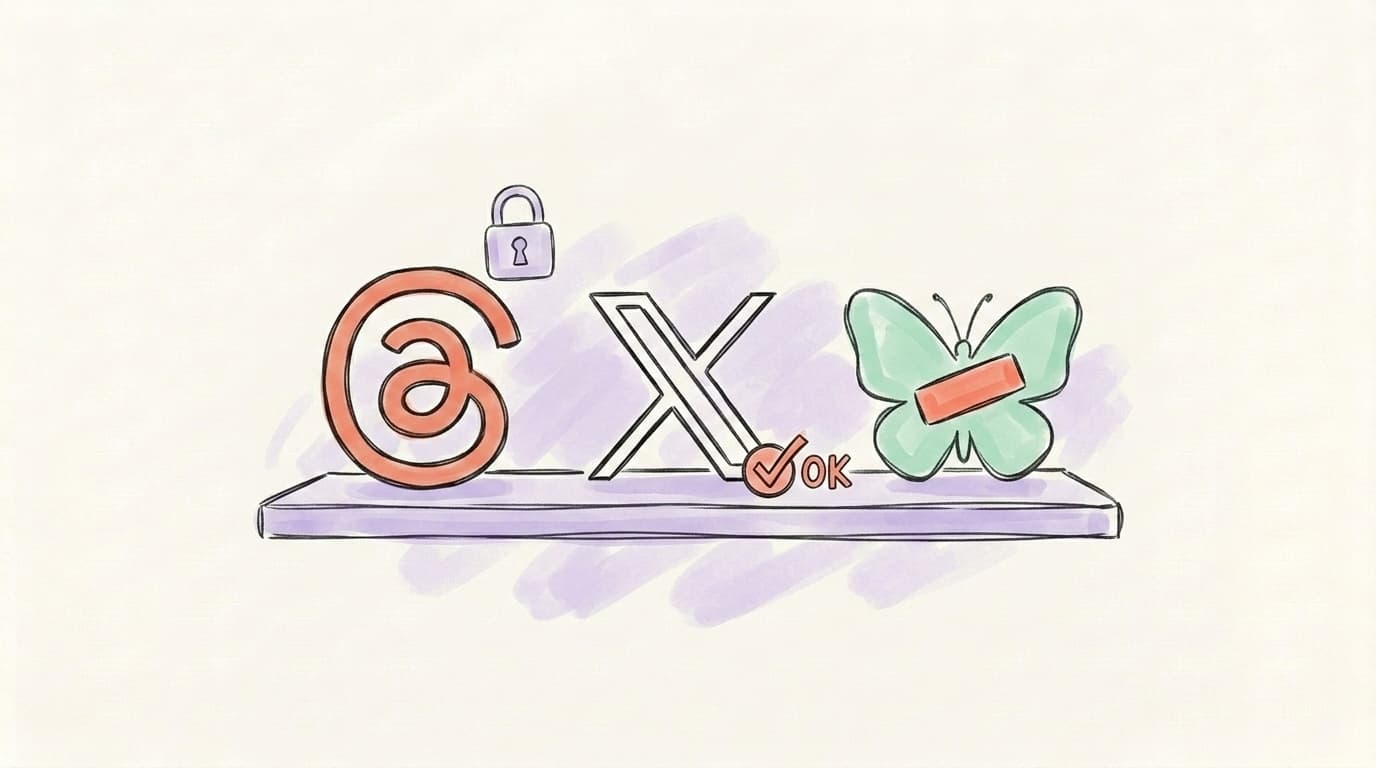
- Threads — Adult content is not allowed, period. No labels, no opt-in, no monetization tier. Automated classifiers remove posts before most users see them.
- Instagram — Same Community Standards as Threads (they share Meta's enforcement backend). Slightly more lenient in practice for borderline fitness and fashion content because the visual platform has more context to work with.
- X (Twitter) — Allows consensually produced and distributed adult content, as long as it's labeled and kept out of highly visible places like profile pictures, headers and List banners, per X's Adult Content policy. Labeled content sits behind a content warning, and viewers under 18 — or with no birth date on their profile — can't click through.
- Bluesky — Allows adult content with four self-label values (
porn,sexual,nudity,graphic-media) — displayed in the UI as Adult, Suggestive, Nudity, and Graphic Media — per Bluesky's moderation documentation. Users opt in to see each category. Stricter on non-consensual or synthetic adult content than X.
The practical takeaway: if you cross-post from X to Threads without thinking, you will eventually get something removed. Content that earns a sensitive-media label on X is content that gets deleted on Threads.
What Should You Do If Your Threads Account Is Flagged?
If Threads removes your post or restricts your account, you have a narrow window to appeal — and a few specific things you can do that actually increase the chance of getting reinstated. The appeal process is automated by default, which means a human only reviews your case if your submission survives the first-pass triage. That's why the wording of your appeal matters more than most people realize, and why generic "please review" appeals tend to fail. Reports from Meta's own Community Forum and platform-recovery guides like Postbase's appeal walkthrough all converge on the same playbook. Move quickly — appeals submitted within 24 hours of the action have a better track record than ones submitted a week later, and you typically only get one appeal per violation, so don't waste it on a vague request.
- Open the in-app appeal first. Threads shows an "Appeal" or "Disagree with decision" button in the notification when content is removed or your account is restricted. Tap it before doing anything else — this routes the case into the standard review queue.
- Write a calm, factual appeal. State what the post said or showed, reference the specific Community Standard you believe wasn't violated, and keep it under a paragraph. Human reviewers spend less than a minute per case, so brevity helps.
- Don't repost the flagged content. Reposting the same content while an appeal is pending is the fastest way to escalate from a single-post removal to an account-level restriction.
- Document everything. Screenshot the violation notice and any messages from Meta. If the issue isn't resolved through the in-app appeal, this is what you'll attach when you submit a follow-up through the Instagram Help Center (which is also the support route for Threads).
- Wait, then escalate. Appeals can take 24 hours to two weeks. If a few weeks pass with no response, submit a fresh appeal through the Help Center — sometimes the first one doesn't get logged correctly.
If your account is restricted for repeated violations, the patterns get worse, not better. Posting habit changes — not deleted offenders — are what gets accounts back to a healthy state. If you suspect quiet suppression rather than an outright flag, our Threads shadowban guide walks through the diagnostic steps; the Instagram shadowban guide covers the parallel situation on IG (and since Meta shares enforcement, both are often connected). For the cross-platform recovery playbook, see how to fix a shadow ban. If you'd rather confirm than suspect, our free Threads shadowban test reads the outsider view for you — whether your profile loads and whether your handle comes back in people search when nobody's logged in — which is exactly what quiet suppression breaks first. On X the automated check goes deeper, because X search is public: the free Twitter shadowban test also covers ghost ban and reply deboosting.
Are There Safer Alternative Platforms for Adult Creators?
If your content sits in the adult bucket, Threads is the wrong tool. Trying to make it work is a losing fight against the automated classifier, and the account history damage compounds with every removal — eventually limiting reach even on the SFW posts that should be safe. Better to use Threads for what it is, a SFW conversation platform, and run your adult-content distribution elsewhere on platforms designed for it. The good news is that the landscape has matured in 2026, and there are now several platforms with stable, predictable rules for adult creators. The pattern most working creators follow is a clean separation: SFW funnel content on Meta apps, labeled top-of-funnel on X or Bluesky, and the actual paid product on a subscription platform built for adult creators where the policy isn't going to flip every quarter.
- X (Twitter) — Best for promotion and audience-building: labeled adult content is allowed, which is more than Meta gives you. Monetization is the caveat. X's content monetization standards list adult and sexual content among the categories that face restricted monetization, and set eligibility requirements on top of that — so subscriptions, tips and paywalls aren't something to count on for an adult account, and asking for payment in exchange for sexual services is prohibited outright. Treat X as top-of-funnel and keep the paid product on a platform built for it.
- Bluesky — Allows adult content with proper labeling and has a growing creator base. Less monetization infrastructure than X today, but useful for distribution and discovery.
- Fansly, JustForFans, LoyalFans, Fanvue — Subscription platforms purpose-built for adult creators, with stable policies that don't get rewritten every quarter. Used as the primary monetization layer by most working adult creators in 2026.
The pattern most working creators settle on: a SFW account on Threads/Instagram for the public-facing brand, a labeled-content X profile for top-of-funnel awareness, and a paid platform (Fansly or similar) for the actual subscription product. Keeping these channels separate protects each account from the others' enforcement risk.
Keep Your Threads Drafts Policy-Safe with Postory
Most policy removals happen because borderline drafts ship without a second look — keep them somewhere you can edit before the classifier sees them.
Keep your X, Threads, and Bluesky drafts policy-safe and organized in Postory's post management board. Draft, Ready, and Scheduled columns keep ideas in one place until you move them to Ready, then schedule them out — so borderline content gets a second look before the classifier ever sees it. It's the same workflow we use to keep our own posts out of trouble.
Try Postory free — draft your Threads posts somewhere you can review them before they hit the algorithm.
FAQ
Q: Can I post lingerie photos on Threads?
It depends on framing. Product-focused lingerie shots that are styled like fashion editorial usually pass. Body-focused shots — tight crops, suggestive poses, low-angle framing — frequently land in the "sexually suggestive" bucket and get suppressed or removed. If you're not sure, post a less risky version first and see how distribution looks before pushing the line.
Q: Will Threads ever add an adult content mode like X did?
Nothing in Meta's public roadmap suggests it. Meta has consistently positioned Threads as advertiser-friendly and family-safe — the opposite direction from X's labeled-adult model. Betting your distribution strategy on a future policy change is not a safe plan.
Q: What happens if my Threads post is removed?
You'll get a notification in-app explaining which Community Standard was violated. You can appeal directly from that notification. The post stays removed during the appeal. Repeated removals lead to account-level restrictions: limited posting, limited reach, or temporary suspension.
Q: Does Threads remove text-only sexual content?
Yes. Sexually explicit language and sexual solicitation are both covered by Meta's Community Standards. You don't need an image attached for a post to be removable on policy grounds.
Q: Why does some borderline content stay up on Threads?
Meta's classifiers run on probability, not certainty. Some content slips through the first pass and only gets removed later when reported by another user. "It's still up" is not the same as "it's allowed" — the policy applies retroactively, and old posts can be removed months after publishing.
Q: Can artistic nudity stay on Threads?
In theory, yes. Meta's policy includes exceptions for nudity in art with clear artistic context. In practice, the automated systems remove most nude images first and only restore them on successful appeal. If you post art, expect to appeal — and keep the original file and any context that proves intent.
Q: Does Threads share enforcement with Instagram?
Yes. Meta's unified Community Standards cover Facebook, Instagram, Messenger, and Threads under one rulebook and one enforcement backend. A violation on one platform can affect your standing across all four. Account history is shared.
Q: Is "Content Not Available" always a policy issue?
No. As covered above, the three biggest causes are private-account permissions, a removed post, and a technical glitch or region lock. Permissions are the most common. If you're seeing the message repeatedly across different accounts, it's more likely a connection or app-version issue than mass policy enforcement.
Related articles
Does X Delete Inactive Accounts? What the Policy Says
Does Twitter delete inactive accounts? X's policy says accounts may be removed for prolonged inactivity — but it names no deadline. Here's what it says.
Sep 9, 2026
How to Remove Followers on X
How to remove followers on X, step by step — what it actually changes, what to check when the option won't show up, and what to do about bot followers.
Sep 7, 2026
"Rate Limit Exceeded" on X/Twitter: What It Means, How Long
X says "Rate limit exceeded"? What the error means, how long it lasts, why it is not a shadowban, and what to do while you wait.
Sep 7, 2026