

How to Create a Content Strategy for Social Media?

A social media content strategy is the plan that decides why you post, who for, what about, where, and how you'll know it's working. Skip the plan and you end up posting random posts that perform randomly. This guide walks you through six decisions — plus a template you can copy.
Most "social media content strategy" articles are really content creation articles in disguise. They tell you how to write hooks, batch reels, and schedule posts. Useful — but that's execution. Strategy is the layer above: the plan that tells you what to create in the first place. If you can't answer "why are we posting this?" in one sentence, you don't have a strategy yet. Here's how to build one.
What Is a Social Media Content Strategy?
A social media content strategy is a written plan that connects your business goals to the content you publish on social platforms. It answers five questions before you post anything: what outcome are we chasing, who are we trying to reach, what topics will we own, which platforms matter, and how will we measure whether it's working. Think of it as the bridge between "we should be on social media" and "we posted a reel on Tuesday." Without a strategy, every post is a coin flip. With one, every post is a deliberate bet with a reason attached — which means you can learn from what works and cut what doesn't. A strategy is not a content calendar, not a brand voice guide, and not a list of hooks. Those are outputs of the strategy. The strategy itself is the thinking that makes all those outputs coherent.
The strategy is the plan. The calendar, the posts, and the metrics reports are what the plan produces.
If you already have a content calendar but feel like you're just filling slots, you're missing the strategy layer. If that sounds familiar, our guide to building a social media content calendar covers the execution side once the strategy below is in place.
What Goals Should Your Social Media Strategy Target?
Before you pick platforms or topics, decide what you actually want social media to do for your business. Most accounts try to do everything — awareness, sales, recruiting, customer support, thought leadership — and end up doing nothing well. Pick one primary goal and at most one secondary goal for the next 90 days. Everything else gets deprioritized, not because it doesn't matter, but because a focused account outperforms a scattered one. The usual goal categories are awareness (getting in front of new people), affinity (nurturing people who already know you into trusting you), and conversion (turning followers into signups, sales, or leads). Your goal determines your metrics, your platforms, and the kind of content that makes sense.
Use a SMART frame so the goal is actually checkable: Specific, Measurable, Achievable, Relevant, Time-bound. "Grow LinkedIn" is not a goal. "Grow LinkedIn impressions by 50% in 90 days by posting 4x per week on hiring and team culture" is a goal.
Quick tests for each goal category:
- Awareness — Can you name the exact audience you want to reach? If you sell to CFOs, following count is meaningless unless those followers are CFOs.
- Affinity — Do people engage more than once? Repeat engagement (saves, replies, DMs) is the real affinity metric, not like counts.
- Conversion — Can you trace at least one signup or sale back to social in the last 30 days? If not, either your funnel is broken or social isn't the right conversion channel yet.
Content planner
Plan a month of content in an afternoon
Map out your posts on a visual calendar, batch your ideas, and never stare at a blank page again.
Who Are You Creating Content For?
Audience research is the step almost everyone skips and almost everyone should do. "Small business owners" is not an audience — it's a demographic group so broad it tells you nothing about what to post. A useful audience definition describes a specific person with a specific problem at a specific moment: solo founders 6-18 months in, still doing sales themselves, losing an hour a day to social media, considering hiring but not ready to commit. That level of specificity lets you write posts that sound like you're talking to one real person, which is what actually converts. Broad posts get broad engagement — a little from everyone, enough from no one. The tighter you define the audience, the sharper the content gets.
Three questions worth answering in writing before you post anything:
- Where are they stuck right now? What's the problem your content should help solve? If you can't name it, you don't know them well enough yet.
- What are they already reading or watching? This tells you which platforms they actually use and which creators they trust. Your content competes with those creators, not with other brands.
- What would make them share a post with a colleague? Shares beat likes every time — they come from posts that make the reader look smart for sharing, not just ones that feel good.
If your audience is on LinkedIn specifically, our LinkedIn content strategy guide goes deeper on audience positioning for that platform.
What Are Content Pillars and Why Do They Matter?
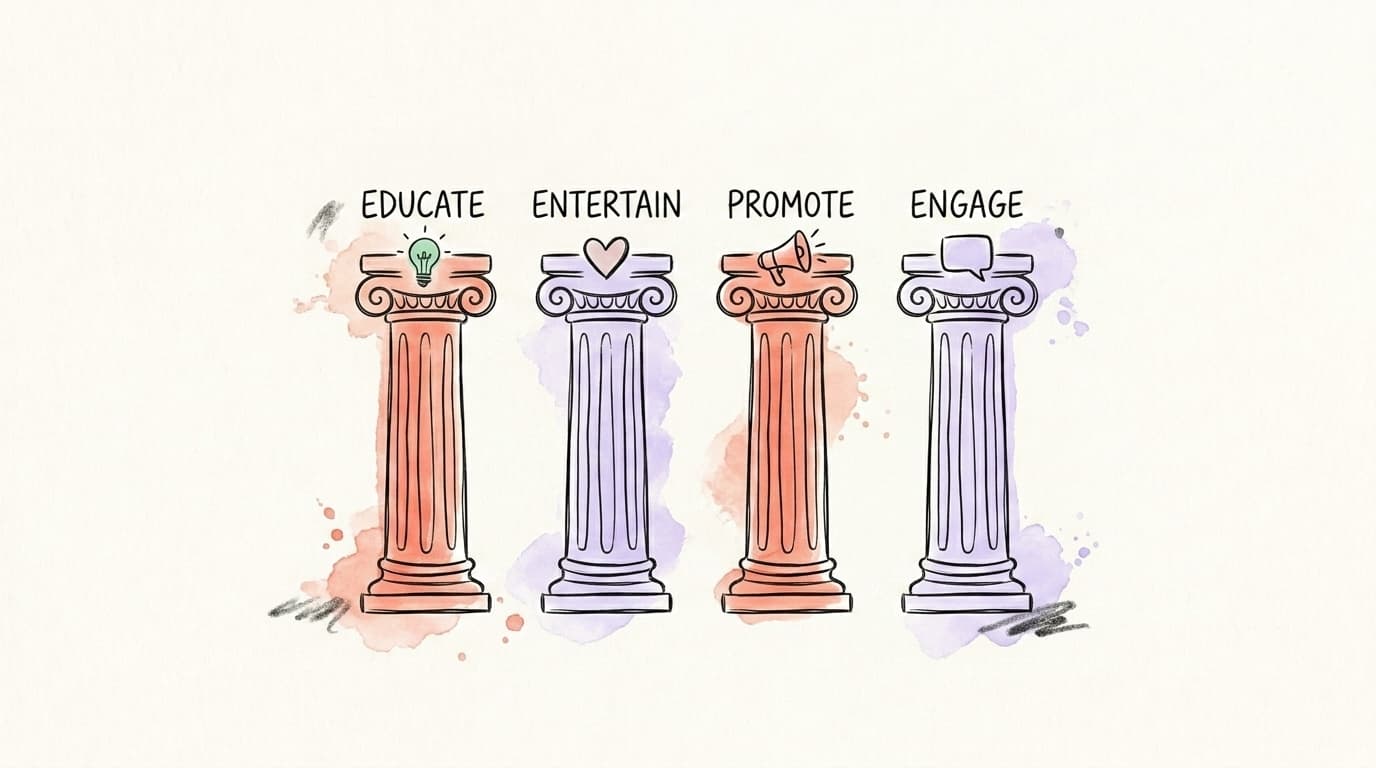
Content pillars are the 3-5 recurring themes your account owns. They exist so you're not reinventing the wheel every time you post — instead of thinking "what should I post today?" you think "it's Tuesday, we post a teardown on Tuesdays, which teardown?" That's the job of a pillar: to narrow the creative decision from infinite to finite. Pillars work best when they sit at the intersection of three things — what your audience wants to learn about, what your business actually sells, and what you can credibly talk about because of who you are or what you do. Most brands land on three to five pillars, per Sprout Social's research. Fewer than three and your account feels one-note. More than five and you lose the pattern recognition that makes an account feel like an account and not a random feed.
Two ways people structure pillars:
By purpose — Educate, Entertain, Promote, Engage. Works well for service businesses and creators where the mode of the post matters more than the topic.
By topic — e.g., for Postory: AI post writing, scheduling workflows, platform growth tactics, creator productivity. Works well when your audience follows you for subject expertise.
A simple rule: you should be able to look at your last 30 posts and sort every single one into a pillar. If more than 10% don't fit, your pillars are wrong or you're posting off-strategy. Both are fixable. Keep the pillars, cut the noise.
Which Platforms Should You Focus On?
You do not need to be everywhere. You need to be in the two or three places where your audience already spends time, and you need to be excellent in those places rather than mediocre on six. Platform selection is a function of your audience (where are they?), your goal (what does this platform reward?), and your content format strengths (can you actually execute on what wins here?). If you can't make short vertical video, TikTok isn't going to work no matter how much you want it to. If your audience is B2B buyers, LinkedIn and X/Twitter carry more weight than Instagram regardless of follower counts. Engagement rates also vary wildly — industry benchmarks consistently show median engagement well under 1% on most platforms, so "is anyone actually seeing this?" matters more than raw reach.
Quick platform fit check:
- X/Twitter — Real-time conversation, commentary, and link-out. Rewards consistency and opinionated takes. Good for B2B, SaaS, tech, media.
- LinkedIn — Professional context, longer-form text, career and business topics. Rewards personal stories and practical frameworks. Strongest distribution for B2B.
- Threads — Meta's text-first network, lighter and more conversational than LinkedIn. Rewards replies and curiosity-driven takes. Still a growth frontier — worth testing if your audience is already there.
- Instagram — Visual-first, reels-driven. Rewards aesthetic consistency and repeatable formats. Good for lifestyle, consumer, creator brands.
- TikTok — Short vertical video, algorithm-driven discovery. Rewards hooks and pacing. Broad consumer reach.
- YouTube — Long-form video and Shorts. Rewards depth and searchability. Strongest for education and tutorials.
For most businesses, the right move in 2026 is two primary platforms plus one experiment. Not five.
Here's Latasha James walking through how she thinks about strategy differently depending on the brand she's working with — particularly useful for the goals-and-audience layer above:
What Content Mix Actually Works?
Once you have pillars and platforms, you need to decide the mix of formats and post types. A useful heuristic is the 70/20/10 rule: 70% of posts deliver value to the audience (educate, entertain, inspire), 20% share other people's work or amplify conversations (curate, comment, reply), and 10% are directly promotional (launches, CTAs, offers). The exact ratios don't matter as much as the principle — if you flip it and post 70% promo, your engagement collapses because nobody follows an account that only sells. The mix also needs to cover multiple formats per platform. On LinkedIn, that might be text posts, document carousels, and the occasional video. On X, it's single tweets, threads, and replies. On Threads, short text and image posts. Variety keeps the feed interesting; pillars keep it coherent.
A sensible starting mix for most brands:
- 50% educational or useful — the posts that make people follow you in the first place
- 20% proof or examples — case studies, before/afters, results, demos
- 15% personal or behind-the-scenes — the human layer that builds affinity
- 10% promotional — products, launches, CTAs
- 5% community or reply-bait — questions, polls, conversation starters
Adjust the ratios as you learn what your audience actually rewards. The numbers are a starting point, not a law. For the execution side — how to actually write the posts — our guide to creating content for social media covers formats and workflows in depth.
How Do You Know If Your Strategy Is Working?

Measurement is where most strategies die. Either people track everything (and learn nothing) or they track nothing (and guess forever). The honest answer is that you only need a handful of numbers, tied directly to the goal you set at the start. If your goal was awareness, track reach, impressions, and follower growth — and watch who is following you, not just how many. If your goal was affinity, track saves, shares, replies, and DMs — the signals that someone cared enough to act. If your goal was conversion, track link clicks, signups from social attribution, and assisted conversions in analytics. The point is: don't track metrics that don't map to your goal. Likes are a vanity metric for a B2B lead-gen account and a critical metric for a consumer brand chasing awareness — context decides, not the metric itself.
Review cadence that actually works:
- Weekly — which individual posts outperformed (top 3) or underperformed (bottom 3). Look for patterns.
- Monthly — pillar-level performance. Is one pillar carrying the account while another flops? Rebalance.
- Quarterly — strategic review. Did we hit the SMART goal? What changed in audience, platform, or business context? Adjust the strategy.
Most accounts never do the quarterly review and wonder why they're still posting the same stuff that stopped working six months ago. Calendar it.
A Simple Social Media Strategy Template You Can Steal
Here's the whole thing on one page. Fill it out before you write your next post:
1. GOAL (90 days)
   Primary: _______ (awareness / affinity / conversion)
   SMART version: _______

2. AUDIENCE
   One specific person: _______
   Their problem: _______
   Where they already hang out: _______

3. PILLARS (3-5)
   Pillar 1: _______
   Pillar 2: _______
   Pillar 3: _______
   Pillar 4 (optional): _______
   Pillar 5 (optional): _______

4. PLATFORMS
   Primary: _______ (posting cadence: _______)
   Secondary: _______ (posting cadence: _______)
   Experiment: _______ (posting cadence: _______)

5. CONTENT MIX
   ____% educational
   ____% proof/examples
   ____% personal/BTS
   ____% promotional
   ____% community

6. MEASUREMENT
   Primary metric: _______
   Review cadence: weekly / monthly / quarterly
Print it. Pin it. If a post you're about to publish doesn't clearly map to this page, don't publish it.
Execute Your Strategy with AI Content Creation and Scheduling
Strategy is the plan. Execution is where it lives or dies — and execution for social media means writing enough good posts, consistently, on the right platforms, without burning out. That's where Postory fits in. Once your pillars and platforms are set, Postory's AI post writing turns outlines and ideas into platform-native posts for X, Threads, and LinkedIn, and the scheduler publishes them on cadence so you're not manually posting at 9 p.m. on a Tuesday. The strategy tells you what to post. Postory handles getting it out.
Try Postory free — plan your content strategy, then let AI create and schedule the posts that execute it.
FAQ
Q: What is the difference between a social media strategy and a content strategy?
A social media strategy covers everything your brand does on social — advertising, community management, customer support, organic content. A social media content strategy is the subset focused specifically on what you publish organically: pillars, formats, cadence, and measurement. Content strategy lives inside the broader social media strategy.
Q: How often should I update my social media content strategy?
Do a light review monthly (is pillar performance shifting?) and a full strategic review quarterly (did we hit the goal, is the audience definition still right, should platforms change?). Full rewrites usually happen once a year or when the business changes meaningfully.
Q: How many content pillars should I have?
Three to five. Fewer than three and your account reads one-note. More than five and neither you nor your audience can see the pattern. Most brands land on four.
Q: Do I need to be on every social platform?
No — and trying usually hurts more than it helps. Pick two platforms where your audience actually spends time, be excellent there, and add a third as an experiment only once the first two are running smoothly.
Q: What's the best social media strategy template?
The simplest one you'll actually use. A single page covering goal, audience, pillars, platforms, content mix, and measurement beats a 40-page deck nobody opens. Use the template in the section above.
Q: How do I measure if my social media content strategy is working?
Pick one primary metric tied directly to your goal — reach for awareness, saves/replies for affinity, clicks/signups for conversion — and review it weekly at the post level, monthly at the pillar level, and quarterly at the strategic level. Ignore metrics that don't map to your goal.
Q: How long before a new social media strategy starts working?
Usually 60-90 days to see meaningful signal. Algorithms need consistent posting to learn what your account is, audiences need repetition to recognize your pillars, and compound effects (shares, saves, repeat engagement) take weeks to build. If you're tempted to scrap a strategy in week three, don't — finish the 90-day test first.
Related articles
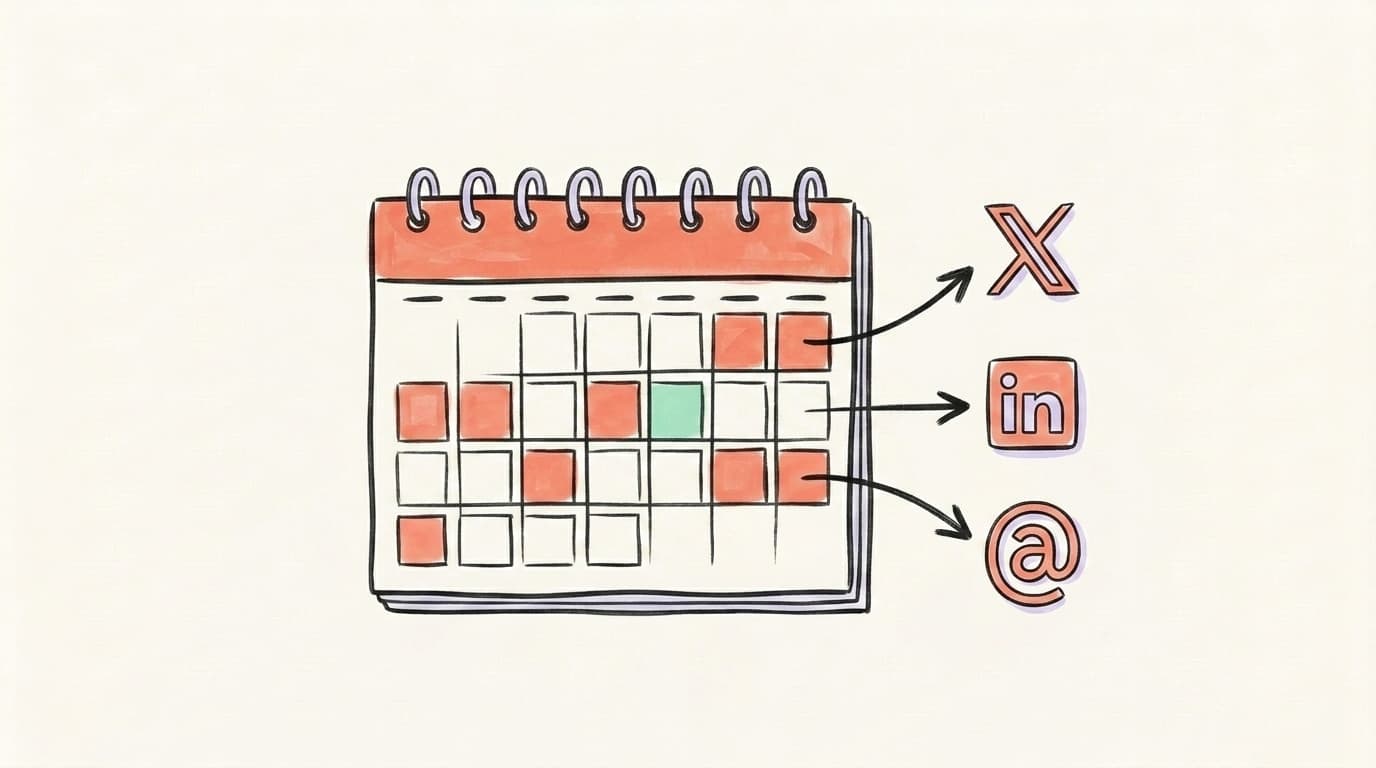
The Cross-Platform Calendar: Planning X + LinkedIn + Threads Together
One calendar for X, LinkedIn, and Threads — the template, slot strategy, and workflow that saves you about two hours a week.
May 20, 2026

Content Batching: A Month of Posts in One Afternoon
Stop writing posts the morning they go live. Here's the exact afternoon workflow that turns one focused session into 30 days of content.
Jun 28, 2026

Social Media Audit Checklist: 20 Points in 30 Minutes
A 20-point checklist to audit your X, LinkedIn, and Threads profiles in half an hour and learn how to create content for social media that lands.
Jun 19, 2026