

How to Get More Followers on Social Media?

Follower growth on any platform comes down to two things: pick one clear niche, and post consistently enough for the algorithm to notice (3–5 times per week minimum). Everything else — hashtags, trending audio, paid ads — is optimization on top of that foundation.
The tactics change every six months. The rules haven't. Algorithms rewrite themselves, formats come and go, but what still works is a small set of principles that apply across LinkedIn, X, Threads, Instagram, and TikTok.
This is a hub guide to how to get more followers on social media — the cross-platform playbook. For deep dives on specific platforms, jump to our guides on how to grow on LinkedIn and how to grow on Twitter/X.
What Actually Drives Follower Growth on Any Platform?
Follower growth on any social platform comes from a single equation: reach (how many people see you) times conversion (what percent of them decide to follow). Every tactic you'll ever read about is trying to move one of those two numbers. Reach is mostly the algorithm's decision — it rewards posts that get early engagement, watch time, and saves. Conversion is mostly yours — it depends on whether a first-time viewer can tell within three seconds what you post about and why they should care. When Buffer analyzed over 100,000 users across 26 weeks, accounts that posted consistently for 20+ weeks saw around 450% more engagement per post than sporadic posters. Consistency compounds because each post is a lottery ticket for reach, and a clear niche compounds because every follower you earn brings in a similar one. If you only remember two things from this guide: pick a niche, then show up often enough that the algorithm can learn who to send you.

Which Content Pillars Attract the Most Followers?
Content pillars are the 3–5 recurring topics that make up everything you post. They matter for growth because followers decide whether to stay based on your second, third, and fourth post — not your first. If every post is about something different, nobody can predict what they're following, and they bounce. The pillars that consistently attract followers across platforms are: (1) teach — practical how-tos in your niche, (2) opinion — a clear take that not everyone agrees with, (3) behind-the-scenes — the process or work that produces your expertise, (4) stories — specific experiences with a lesson, and (5) curate — your take on what's happening in your industry. You don't need all five. Most fast-growing accounts pick two or three and rotate. The universal rule: whatever pillars you pick, someone seeing your profile for the first time should be able to describe what you post about in one sentence. If they can't, you don't have pillars yet — you have a personal journal.
Grow on autopilot
Grow your account without the guesswork
Postory turns what works into a repeatable posting system across X and Threads — so you grow consistently.
How Does Growth Differ Platform by Platform?
Growth rates and dynamics vary massively across platforms right now, and picking the right one for your niche matters more than any posting trick. Socialinsider's latest benchmarks show LinkedIn pages with 1–5K followers growing at roughly 24.5% annually, while larger pages have slowed to single digits. Social Media Today reports TikTok leading raw follower growth, with Instagram tightening and X seeing flat to slightly negative median growth for brand profiles (though early 2026 engagement is ticking back up). Threads is the fastest-moving opportunity for text creators right now — it's less saturated than X, and the follower-growth curves on text-first posts still look closer to early-X than mature-X. The lesson: don't pick the platform with the "best" numbers in the abstract — pick the one where your specific audience already is, because a fast-growing platform is useless if your buyers aren't there. A financial advisor will grow faster on LinkedIn than on TikTok even though TikTok's raw numbers are higher, simply because LinkedIn's audience is wired to care about financial advice.
Here's the rough cross-platform picture for 2026:
- LinkedIn: Best for B2B, expertise-driven content. Slower but higher-value followers.
- X: Slower follower growth, but high-signal audience. Good for tech, finance, creators.
- Threads: Early-mover advantage. Text-first, less competition than X.
- Instagram: Slowing follower growth but huge audience. Reels are the only reliable growth vector.
- TikTok: Fastest raw growth. Short video only — not a fit for every niche.
For platform-specific playbooks, see how to grow on LinkedIn and how to grow on Twitter/X.

Why Does Consistency Beat Quality for Growth?
This one feels wrong when you first read it, but the data keeps proving it out. Moving from one post per week to three to five posts per week produces a sharp lift in views per post, as the Buffer study above showed, and each additional post gives the algorithm a fresh signal about who should see your content. The reason consistency beats "quality" isn't that quality doesn't matter — it's that you don't actually know what will work until you ship enough posts to see patterns. Creators who post five times per week find their winners in weeks, not months. A creator who posts once a week with a "masterpiece" takes six months to learn the same lesson, and by then the algorithm has cooled on their profile. Consistency also trains your audience: people follow accounts they expect to hear from. If you disappear for two weeks, your re-emergence post performs worse because the algorithm de-weights stale accounts. Pick a cadence you can sustain — three posts per week is enough — and protect it like a gym schedule.
Here's a Kallaway breakdown of exactly how to systematize social media growth in 2026 — it's strategic, not tactical:
Can You Turn LinkedIn Followers Into X Followers?
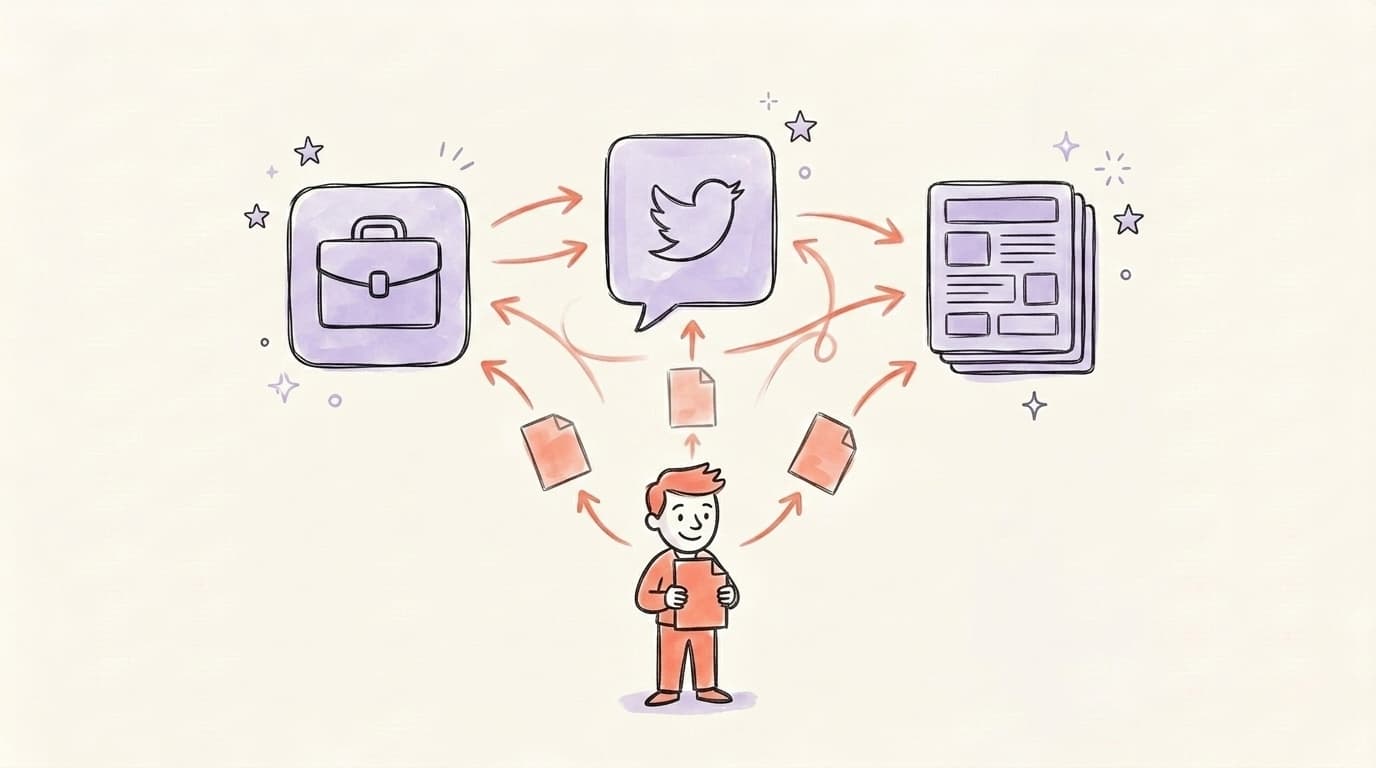
Yes — and this is one of the most under-used growth tactics. Most people on LinkedIn also use X or Threads, but they're following a completely different set of creators on each. If you show up in both places with a consistent voice, you get a second shot at the same person. The trick is that cross-posting raw text rarely works. A post that crushes on LinkedIn (long, structured, professional tone) often flops on X (which rewards punchier, more opinionated writing). The right move is to treat one piece of content as the source and adapt it per platform: the insight stays, the format changes. A 250-word LinkedIn post becomes a 5-tweet thread on X becomes a three-post sequence on Threads. You're not duplicating — you're translating. Over time, your most engaged followers will start following you on all three, which multiplies your reach whenever you post something great. Cross-platform creators also have a huge defensive advantage: if one algorithm turns on them, they don't lose everything.
Should You Invest in Organic or Paid Growth?
For almost every creator and small business, the answer is: build organic first, layer paid on top once you have a proven winner. Sprout Social's analysis of organic vs. paid puts it clearly: in the early stage, prioritize organic to learn what resonates and build authentic trust. Paid ads amplify what's already working — they don't fix a product-market fit problem with your content. The practical test: if a post organically hits 3–5x your average reach with strong engagement, that's the kind of content worth boosting. Boosting mediocre posts just buys you more mediocre reach. Paid growth makes more sense when you have a defined conversion goal beyond followers (email signups, free-trial starts, product sales) and you know which content theme converts. For pure follower growth, most paid tactics deliver low-quality followers who won't engage later, which hurts your organic reach because the algorithm reads low engagement as a signal to show your posts to fewer people. Grow organically until you have signal, then use paid surgically.
What Tools Help You Manage Multi-Platform Growth?
Once you commit to posting on more than one platform, your biggest enemy becomes context-switching: writing in LinkedIn's editor, then logging into X, then Threads, then wondering what you posted where. The right tools collapse that workflow. At minimum you want: (1) one place to draft and adapt content for each platform, (2) a scheduler so you're not manually posting at 7am, and (3) a way to see what worked across platforms in one view. There are two broad tool categories: traditional schedulers (Buffer, Hootsuite, Publer) that just queue posts, and AI-assisted multi-platform tools (Postory, Typefully) that help you write and adapt for each platform. The traditional schedulers are fine if you already know exactly what to write; the AI-assisted ones are better if you're trying to move faster or manage more platforms than you have writing capacity for. Whichever you pick, the tool itself isn't the edge — consistency is. The tool just removes friction that used to kill consistency for most people.
Start Growing Across All Your Platforms with Postory
The hardest part of multi-platform growth isn't having ideas — it's getting the same idea out to LinkedIn, X, and Threads without writing it three times. Postory is built for exactly that: AI post writing that adapts your content to each platform's voice, multi-platform publishing so one draft goes everywhere, and social media scheduling so you're not glued to a phone.
Try Postory free — write once, post to LinkedIn, X, and Threads.
FAQ
Q: How long does it take to grow a social media following?
Most creators see their first meaningful growth inflection point 3–6 months into consistent posting, assuming they post 3+ times per week and stick to a clear niche. The first 100 followers are the hardest. After that, the algorithm has enough data on your content to start distributing it to similar audiences, and growth tends to accelerate.
Q: Which platform is easiest to grow on in 2026?
TikTok has the fastest raw follower growth if your niche fits short video. Threads is the best under-the-radar opportunity for text-based creators because it's less saturated than X. LinkedIn is the best platform for B2B and expertise niches. "Easiest" depends entirely on what you create — there's no universal winner.
Q: How many followers do I need to make money on social media?
Far fewer than most people think. Creators with 1,000–10,000 highly engaged followers in a specific niche regularly out-earn creators with 100K+ followers who lack focus. What matters is engagement rate and audience relevance to what you sell, not raw follower count.
Q: Should I post the same content on every platform?
No — but you should repurpose the same ideas. A concept that works on LinkedIn usually works on X and Threads too, but the format needs to change per platform. Treat one piece of content as the source, then translate it for each platform's conventions (length, tone, structure).
Q: Do hashtags still work for follower growth?
On Instagram and TikTok, hashtags are weak but not useless — stick to 3–5 relevant ones. On LinkedIn, hashtags have minimal impact on reach. On X, hashtags often hurt reach. Prioritize specific, niche-relevant tags over broad popular ones on any platform where you use them.
Q: How often should I post to grow quickly?
Minimum 3 posts per week on your primary platform, 5–7 if you can sustain it. Buffer found that creators who posted in 20+ out of 26 weeks saw around 450% more engagement per post than sporadic posters. Consistency matters more than frequency — don't start at 7 posts per week if you'll burn out in a month.
Q: Is it better to focus on one platform or grow on multiple?
Start with one platform until you're posting consistently and seeing engagement. Once you have a rhythm (typically 2–3 months in), expand to a second platform by repurposing your best content. Trying to launch on three platforms at once usually means all three get half-effort and none grow.
Related articles
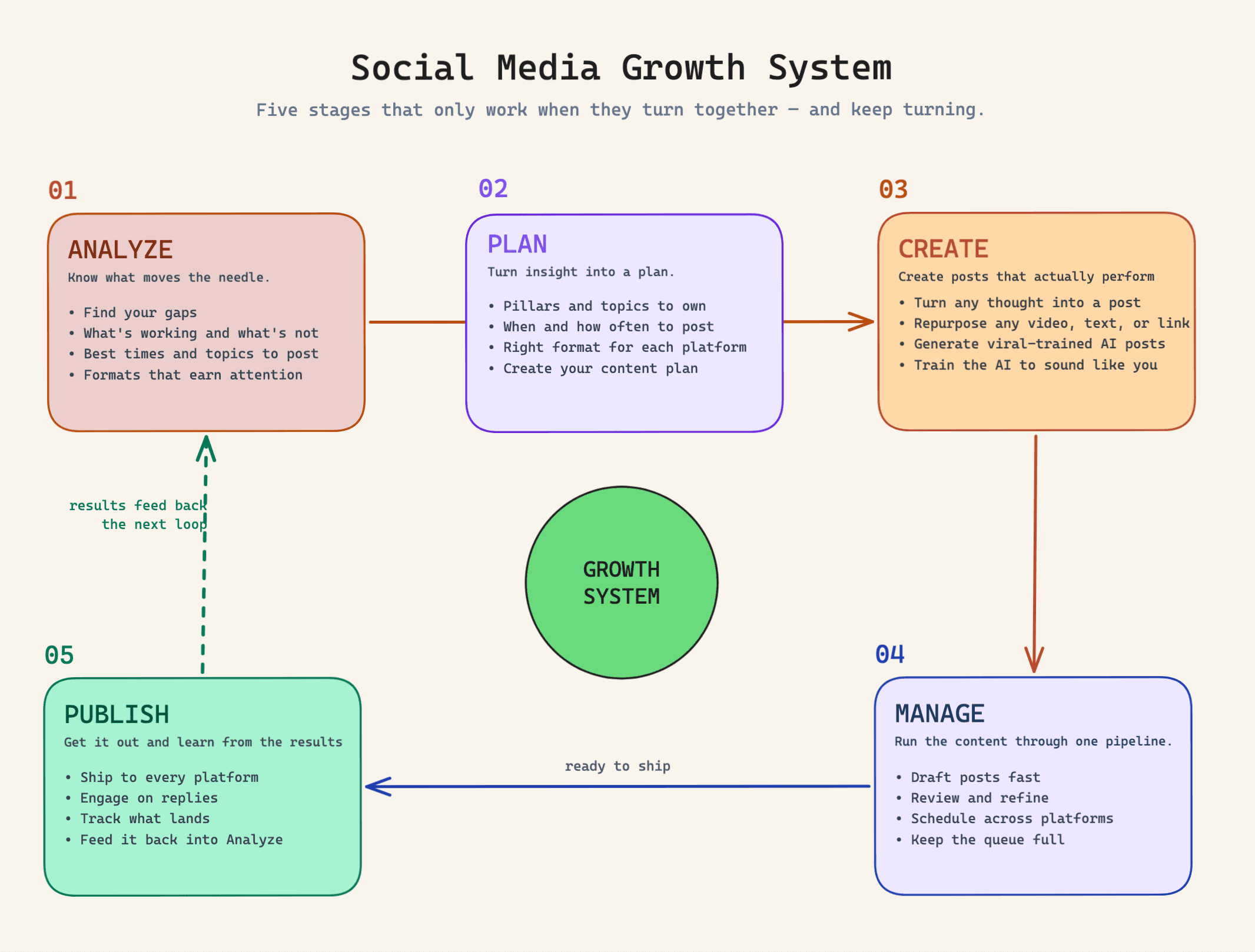
5 Steps to Grow Your Social Media Accounts 10x Faster
Most creators plateau because they skip half the loop. Here's the 5-step system that actually compounds.
Apr 21, 2026
How to Get Your First 100 Followers on X/Twitter
I started a brand new X account with zero followers and had my first 100 real followers a few days later. Here's the exact playbook.
Jul 19, 2026

Social Media Audit Checklist: 20 Points in 30 Minutes
A 20-point checklist to audit your X, LinkedIn, and Threads profiles in half an hour and learn how to create content for social media that lands.
Jun 19, 2026