
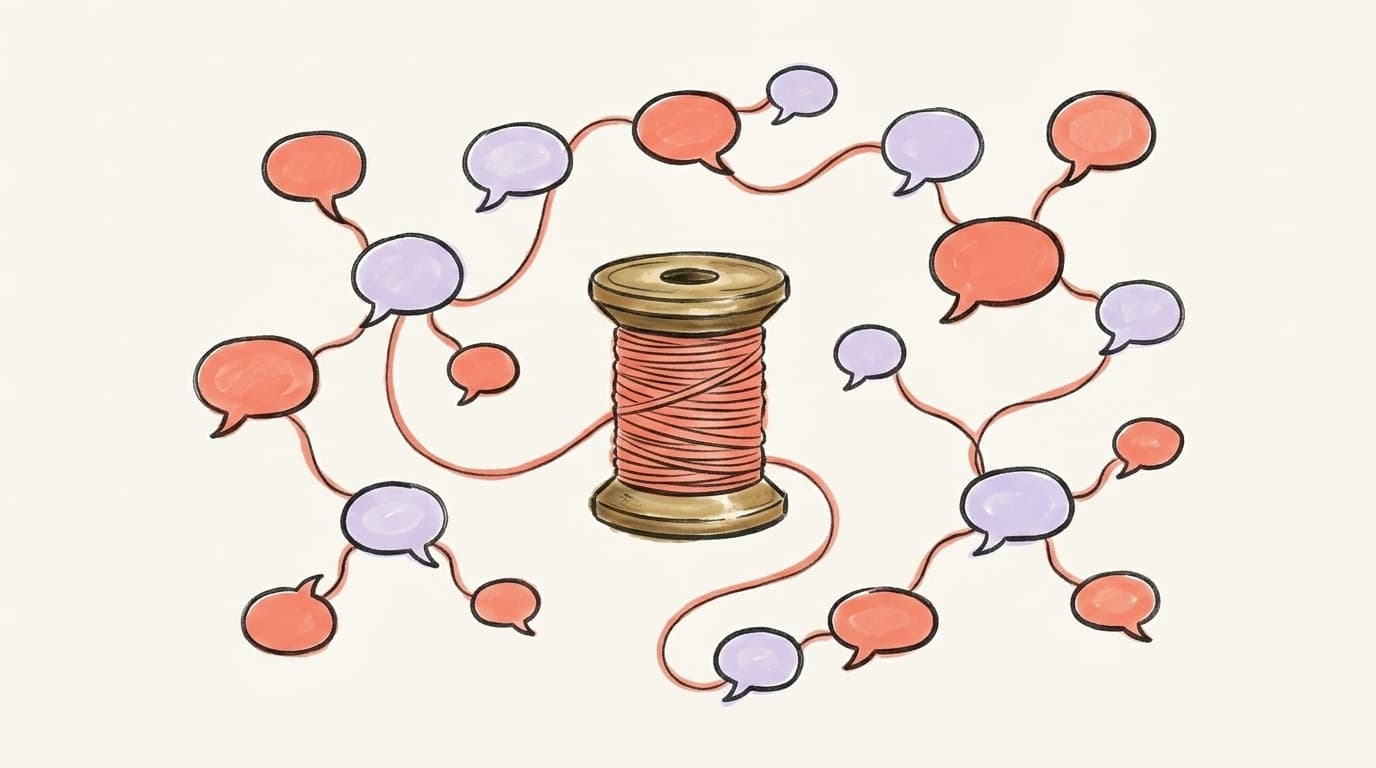
Threads Post Ideas: 40 Hooks for Founders and Creators

Threads rewards conversation, not broadcast. These 40 post ideas — 10 personal stories, 10 low-stakes hot takes, 10 question hooks, and 10 reply-chain carousels — are tuned for the Threads algorithm (replies as valuable as posts), not lifted from your X drafts.
You open Threads, stare at the empty compose box, and bail back to Instagram.
The post ideas that work on X feel too combative here. The ones that work on LinkedIn feel too long. So you sit there, half a thought in your head, and never post.
Below are 40 Threads post ideas grouped by format — 10 personal-story hooks, 10 low-stakes hot takes, 10 question prompts, and 10 reply-chain carousels — each tuned for the way Threads actually distributes content in 2026. Steal one, swap in your details, and ship it.
New to Threads posting? Start with these three this week: #3 (the unglamorous habit), #21 (the easy reply prompt), and #31 (the 4-part reply chain). One personal, one engagement, one carousel-style — covers all three core Threads formats.
Why Threads Post Ideas Don't Translate 1:1 From X
The Threads algorithm and the X algorithm reward different things, and pretending otherwise is the fastest way to post into the void. X's open-sourced ranking weights actually weight replies highest too, but X's culture rewards punchy, declarative takes that pull quote-tweets and reposts — the format is sharper-edged. On Threads, Meta has tuned the feed around conversation depth. Adam Mosseri has publicly told creators that "the sum of all your replies is about as valuable as the sum of all your posts," and Buffer's analysis of 128,000+ Threads posts found that replying to your own comments boosts engagement by roughly 42% — the largest of the six platforms Buffer measured. The practical takeaway: a tweet rewritten word-for-word as a Thread usually underperforms. The format that works here is shorter, softer-edged, and leaves room for someone to reply.

What Personal-Story Hooks Work Best on Threads?
Personal-story posts work on Threads because they invite people to share their own version in the replies. Unlike on LinkedIn — where personal stories are often polished into a takeaway — Threads stories are shorter, messier, and end with a small opening for the reader. The structure that consistently lands is: one specific moment + one honest line about what you took from it + an implicit invitation for someone else to share. Don't oversell the takeaway. The post that says "here's what I noticed today" outperforms the post that says "here's the universal lesson." These ten ideas are built around micro-stories that fit comfortably inside a single Threads post, with a beat at the end that asks the reader to either agree, disagree, or add their own. Lean into texture over polish — the slightly unpolished version is the one that gets replies.
- The thing you almost gave up on last year. One sentence on what it was, one on why you stayed. End on what you'd tell yourself a year ago.
- A conversation today that's still in your head. Quote what they said. Then your honest reaction. People reply with theirs.
- The unglamorous habit that actually drives your work. Not "I wake up at 5am" — something small and specific. The mundane version is the one that resonates.
- A purchase under $50 that quietly changed how you work. Cheap-but-useful posts get saved and shared more than expensive recommendations.
- The moment you realized you'd outgrown an old version of yourself. Specific scene, no moral. Let the reader fill it in.
- A "small win" that no one else would call a win. "I finally cancelled a subscription I'd been ignoring for 2 years." Relatable beats impressive.
- The piece of advice you used to give that you no longer believe. Naming the shift is more interesting than the new belief.
- The compliment that landed wrong. What was said, why it didn't sit right, what you took from it. This kind of post pulls long reply threads from people who've felt the same.
- A weird thing that happened at work this week. Genuine bafflement is rare online — and very replyable.
- The unsexy career move that mattered more than the flashy one. "Taking 3 weeks off" beats "I shipped a launch" because more people relate.
Content calendar
Plan a month of content in an afternoon
Map out your posts on a visual calendar, batch your ideas, and never stare at a blank page again.
Which Hot-Take Threads Posts Get Engagement Without Backlash?
Hot takes on Threads work differently from hot takes on LinkedIn or X. LinkedIn punishes anything that feels combative — the post gets buried in comments arguing semantics and never gets distribution beyond your immediate network. X rewards sharper takes but also weaponizes them, and a strong opinion can pull the wrong crowd into your replies for days. Threads sits in the middle: it rewards a clear, mildly contrarian opinion but penalizes dunks. The trick is the low-stakes hot take — an opinion that's a little spicy but not personal, not political, and not zero-sum. Something where most readers will lean "yeah, kind of" and a few will lean "actually no, here's why," which is exactly the back-and-forth Threads' reply-weighted algorithm rewards. These ten prompts give you the structure without the toxicity.
- "Unpopular opinion: [popular thing in your niche] is overrated. It's fine, just not the gospel." Notice the softener — "it's fine, just not the gospel." Keeps the post from reading as a dunk.
- "I think the way most people do [common task] is backwards. Here's the version I switched to." Give the alternative. Let people argue with the alternative, not with you.
- "[Trendy advice] only works if [specific condition]. Most people skip the condition." Adding the condition makes the take feel earned, not contrarian for sport.
- "The thing nobody mentions about [hot topic] is..." Calling out a blind spot is less risky than picking a side.
- "Two things can be true: [popular take] and [opposite take]." Anti-binary posts pull in both crowds and start nuanced reply threads.
- "I'd rather [boring option] than [exciting option] every single time. Here's why." Defending the unglamorous choice is reliably replyable.
- "This is a small hill but I'm on it: [opinion about something low-stakes]." Hill posts about tabs vs spaces, oat milk, etc. — they perform because they're fun, not because they're important.
- "Most [people in your industry] are solving the wrong problem." Then name the right one. Sharp but not personal.
- "You probably don't need [thing everyone says you need]. You probably need [different thing]." Replacement-frame takes invite a "wait, why?" reply.
- "I changed my mind about [thing] this year. Here's what flipped it." The reverse hot take — admitting you used to hold the popular view and don't anymore.

Which Threads Post Ideas Spark the Most Replies?
Questions are a direct way to invite replies, and replies are what Threads is organised around — Mosseri's line above, and Buffer's self-reply finding, both point at conversation rather than at any particular format winning. But not all questions are equal. "What are your favorite tools?" gets ignored. "What's a $9 tool you'd be sad to lose?" gets dozens of replies. The difference is specificity — the narrower the frame, the easier it is to answer in one breath. These ten conversational question prompts are tuned for that — each one is narrow enough that someone can reply in the time it takes to wait for an elevator, but open enough that the answers aren't all the same. Use them as templates, swap in your niche, and reply to every comment you can in the first 60 minutes.
- "What's a small thing you do every Monday that quietly sets the tone for your week?" Mondays are universal. Small things are answerable. Easy reply prompt.
- "Tell me something you learned last week that you didn't expect to." Genuine curiosity beats engagement bait.
- "What's a piece of software you've used every day for 5+ years?" Longevity questions pull strong opinions and product recommendations.
- "Fill in the blank: I trust people who ____." Open frames where the reader writes the post for you.
- "What's the most useful $20 you've spent this month?" Specific dollar amounts get specific answers.
- "Which book did you reread this year, and what did you notice the second time?" Niche-friendly — works for any field's "books."
- "What's a skill you're glad you forced yourself to learn even though it felt pointless at the time?" Hindsight questions surface great stories.
- "Honest answers only: how many tabs do you have open right now?" Joke-questions get the most replies of any format on Threads.
- "What's a tiny ritual that makes a hard day easier?" Threads' tone is warm — warm questions outperform sharp ones.
- "Quote one line from a book or post that's stuck with you for years." Quote-collection posts have huge save/share rates and pull in lurkers.
How Do Reply-Chain Carousels Work on Threads?
Threads doesn't have native carousels the way Instagram does, but creators have built a workaround that the algorithm loves: the reply-chain carousel. You post the hook as the original post (one sentence, one image if helpful), then reply to your own post with the next "slide," then reply to that with the next, building a 3–7 reply chain underneath. This format works because it stacks every signal the Threads algorithm rewards — your own replies count, the original post stays alive longer, and engagement on any reply pushes the whole chain back into circulation. The hook post is the most important piece — it has to earn the click into the chain. These ten prompts give you battle-tested chain structures: lists, frameworks, story arcs, before/afters. Treat the first line as your hook and the chain as your value.

- The "5 things in 5 replies" list. Hook: "5 things I'd tell a younger version of me about [topic]." Each reply = one thing. Numbered.
- The "before / after" chain. Reply 1 = where you started. Reply 2 = the turning point. Reply 3 = where you are now. Reply 4 = the one thing that made the difference.
- The "I tried X for 30 days" recap. Hook = what you tried + the headline result. Replies = day 1, day 10, day 30, what you'd do differently.
- The mini case-study chain. Reply 1 = the problem. Reply 2 = what you tried first that didn't work. Reply 3 = what actually worked. Reply 4 = the numbers.
- The "ranking" chain. Hook: "I've used 6 [tools/books/methods] in the last year. Ranking them in the replies." Then rank them one per reply, worst to best.
- The framework breakdown. Hook = the name of the framework. Replies = each step, one per reply. Frameworks get bookmarked.
- The "thread of underrated [thing]." Hook = "Underrated [tools/habits/books] thread. Adding one a day in the replies." Then literally do that. The recurring chain keeps surfacing.
- The Q&A chain. Hook = "Asked 5 people in [field] the same question this week. Answers in replies." Each reply = one person's quote.
- The mistake-anatomy chain. Reply 1 = "Here's what I did." Reply 2 = "Here's what I should have done." Reply 3 = "Here's the lesson." Three replies is enough.
- The "I'll go first" chain. Hook = "Drop your most controversial take about [topic]. I'll go first in the replies." Your reply seeds the conversation, then you let the audience fill the chain.
How Do You Recycle One Idea Into a Threads + X + LinkedIn Set?
The fastest way to never run out of Threads post ideas is to stop treating each platform's posts as separate work. One real observation can fill three platforms in a single sitting if you adapt the frame — not the words — for each one. The frame on Threads is conversational ("here's something I noticed, what do you think?"). The frame on X is punchy ("here's the take, fight me"). The frame on LinkedIn is structured ("here's the observation, here's why it matters professionally, here's the takeaway"). Same idea, three different rhythms. The mistake most creators make is rewriting their X post slightly and calling that the Threads version — it carries the X tone with it, which is exactly why the Threads version flatlines. Treat the recycle as a frame swap, not a copy edit. Below is a worked example using one real observation, plus a way to think about which platform each angle goes to.
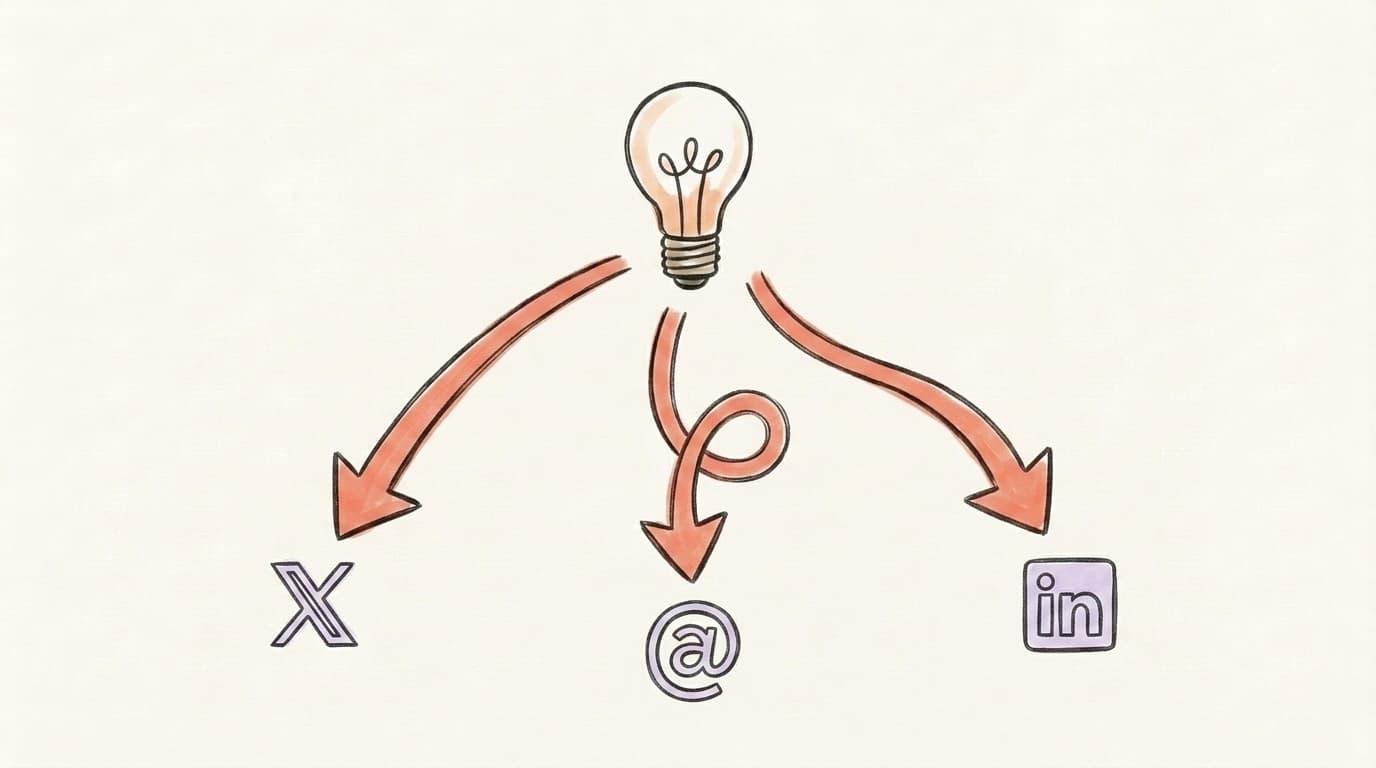
The original idea: I noticed I close the laptop after 5 tabs are open and just give up.
- Threads version: "Honest question: how many tabs do you have open right now? I just realized I bail on work when I hit five. Five." Soft question. Invites replies.
- X version: "5 tabs is the line. Below 5 = working. Above 5 = procrastinating. Anyone else?" Punchy claim, baked-in question, room for quote-tweet.
- LinkedIn version: "I noticed a small productivity tell this week. When I have more than 5 tabs open, I'm not working — I'm avoiding the hard task. The fix: close everything, pick one tab, open the next when that one's done. Small change, real difference." Observation + mechanism + takeaway.
That's three platforms from one observation — about ten minutes of work if you keep the structure in your head. For more of this pattern across formats, see our guides to what to post on LinkedIn and tweet ideas — many of the prompts in those posts can be adapted to Threads with a softer frame.
How Do You Never Run Out of Threads Post Ideas?
The creators who consistently ship on Threads aren't more creative — they're better at capture. They keep a running list of small observations, conversations, contradictions, and questions, and they treat that list as the actual input to posting. The compose box is the output, not the input. If you sit down to write a Threads post from scratch, you'll write one boring post a week. If you sit down with a list of 30 raw observations you've already captured, you'll write five good ones in fifteen minutes. Build the habit of jotting down anything that catches your attention — a sentence from a meeting, a thing that surprised you, a small piece of friction in your day. Then once or twice a week, sit down with the list and turn the rough material into posts.
Here's Chotsani Gordon walking through how that worked for her — posting raw observations she'd already written in her journal, and stumbling into a six-figure side income in the process:
The mechanics — what kinds of formats land, how often to post, what the algorithm rewards — are covered in our deeper post on what's actually working on Threads in 2026. The short version: 2–5 posts a week, replies on other people's posts most days, and one or two reply-chain carousels per week to compound your distribution.
Write Threads + X + Bluesky Versions in One Shot with Postory
If you're running X, Threads, and Bluesky as co-equal platforms, the actual time sink isn't coming up with ideas — it's rewriting the same idea three times in three different voices. That's the gap Postory is built for.
Paste one idea into Postory's AI post writing — get X, Threads, and Bluesky versions in one shot, each in the platform's native tone. Then schedule everything from one place with multi-platform publishing. One idea in, three platform-perfect posts out, all scheduled in under five minutes.
Try Postory free — paste an idea, get Threads + X + Bluesky versions, all platform-perfect, all in one shot.
FAQ
Q: How often should I post on Threads?
Most playbooks point to 2–5 posts per week as the sweet spot. Posting fewer than twice a week and the algorithm never builds momentum for you. Posting more than once or twice a day and your newer post starts cannibalizing your older one before it has time to accumulate replies. Spend the saved time on replies — both to your own posts and to other people's.
Q: Do hashtags work on Threads in 2026?
Threads uses a one-topic-tag-per-post system, not free-form hashtags. A single well-chosen topic tag can give a post a meaningful lift on topic-based surfaces, but adding tags reflexively doesn't help. Pick one tag that genuinely describes the post, or skip it entirely.
Q: Should I just copy-paste my best tweets to Threads?
No. The tone is different enough that a tweet that lands as "sharp" on X often lands as "cold" on Threads. Use your best tweets as the seed — rewrite them with a softer frame, swap the declarative statement for a question, and add an image where it helps. Tools that handle multi-platform publishing make this much faster than rewriting in three tabs.
Q: What's the best time to post on Threads?
The most important factor isn't the time of day — it's whether you're around to reply for the first 60–90 minutes after posting. Because Threads' algorithm leans heavily on early reply velocity, posting when you can engage in real time beats posting at the "ideal" hour and ghosting. If you want platform-specific timing benchmarks, see best time to post on Threads.
Q: Are reply-chain carousels actually different from a long post?
Yes, and the difference is a practical one. A long post presents the idea in one post. A reply-chain carousel breaks the same idea into a sequence of small posts, each one a place where you or someone else can add something — which leaves you more to answer and more to point back at. Whether that out-distributes one long post isn't something we can tell you; it's a structure worth testing on your own account against your own numbers.
Q: How many Threads followers do I need before posts get traction?
Fewer than you'd assume — Threads' recommendation surface still pushes posts from small accounts. Even after Meta's late-2024 rebalance toward followed accounts, the algorithm continues to surface individual posts that outperform an account's follower count when the early reply velocity is strong. Follower count matters less on Threads than on most platforms. A 200-follower account with a sharp question post can outperform a 10K-follower account with a flat statement.
Q: Should I post the same idea to Threads and X on the same day?
You can, but rewrite it for each platform — don't copy-paste. Same observation, different tone: a question or soft frame for Threads, a sharper declarative for X. If you're using a tool with AI post writing, this takes about a minute per platform. The risk isn't cross-posting; it's cross-posting in the same voice.
Related articles

Threads for Business: Is It Worth It in 2026?
Is Meta Threads worth it for B2B in 2026? An honest framework plus four B2B archetypes showing where Threads actually drives ROI.
May 19, 2026
Threads Ads in 2026: Availability, Specs, Costs, How to Run Them
Threads ads are live globally. What formats exist, the current ad specs, what they cost, and how to set one up in Ads Manager.
May 17, 2026
LinkedIn Carousels: Specs, Templates, and Writing Tips
Create LinkedIn document posts with the 2026 specs, six templates, and practical tips for hooks, slide structure, and calls to action.
May 31, 2026