
How to Repurpose Content: Strategy + Step-by-Step

Build one long-form asset a week, extract 10 platform-ready pieces from it, and schedule them across LinkedIn, X, and Threads. You'll post more, create less, and stop burning out chasing blank pages.
If you're publishing every day across three or four platforms, you're not a content machine — you're a repurposing system. Nobody actually writes fresh content five times a day. The creators who look prolific are running the same core ideas through different formats and letting each platform see a version of the same thought.
This guide is the system. You'll learn why repurposing is the only sustainable way to stay consistent, a simple 1-to-10 framework, a step-by-step process, and how to do it fast with AI.
Why Do You Need a Content Repurposing Strategy?
You need a content repurposing strategy because sustainable publishing is a math problem, not a willpower problem. One deep idea, cut into 10 format-specific posts, buys you two weeks of content from a single afternoon of thinking. Without a strategy, every post starts from zero — which is the real reason most creators quit by month three. Repurposing also compounds reach. Each platform's algorithm shows your post to a mostly different audience, so the same idea gets three or four fresh shots at resonance instead of one. Buffer stopped publishing new articles for 30 days and only saw a 4% dip in traffic — while organic search actually went up. That's the leverage. You're not recycling because you're lazy; you're recycling because your best ideas deserve more than one post. A repurposing strategy turns your best thinking into a pipeline instead of a one-shot broadcast.
What Is the 1-to-10 Content Repurposing Framework?
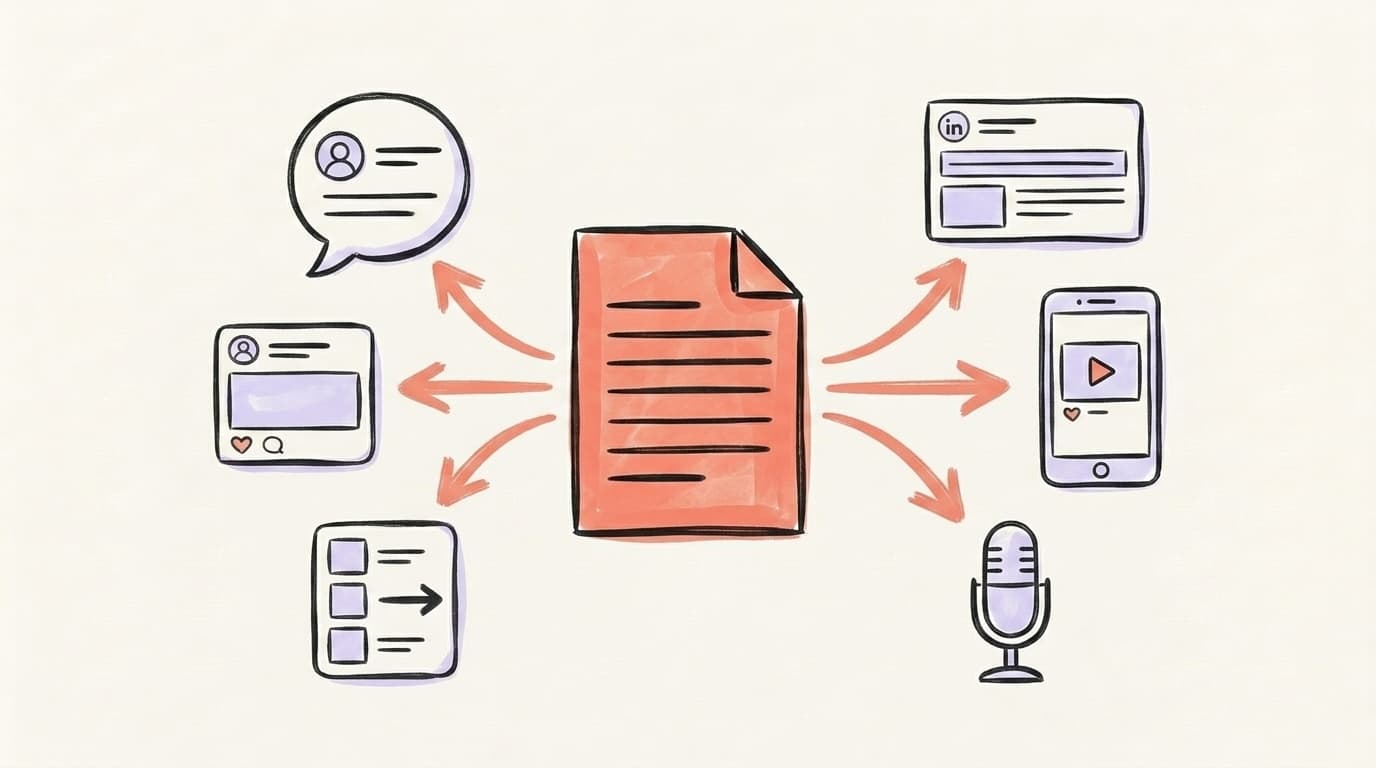
The 1-to-10 framework is a simple rule: every long-form asset you create should yield at least 10 derivative posts before you move on. One blog post, YouTube video, or podcast episode becomes one LinkedIn post, one X thread, two Threads posts, one carousel, one short video, one quote graphic, one email snippet, one reply-bait question, and one "lessons learned" recap. You don't need to hit exactly 10 every time — the rule is directional. It forces you to stop publishing once and move on. This is the classic "hub and spoke" model: one "hub" asset, many "spoke" distributions. The hub is where you do the thinking. The spokes are where you meet the audience. If you're creating a new hub every single day, you're doing it wrong — and you'll be exhausted in a month. The goal of the framework isn't output volume for its own sake; it's forcing each good idea to work harder before you kill it.
How Do You Repurpose Content Step by Step?
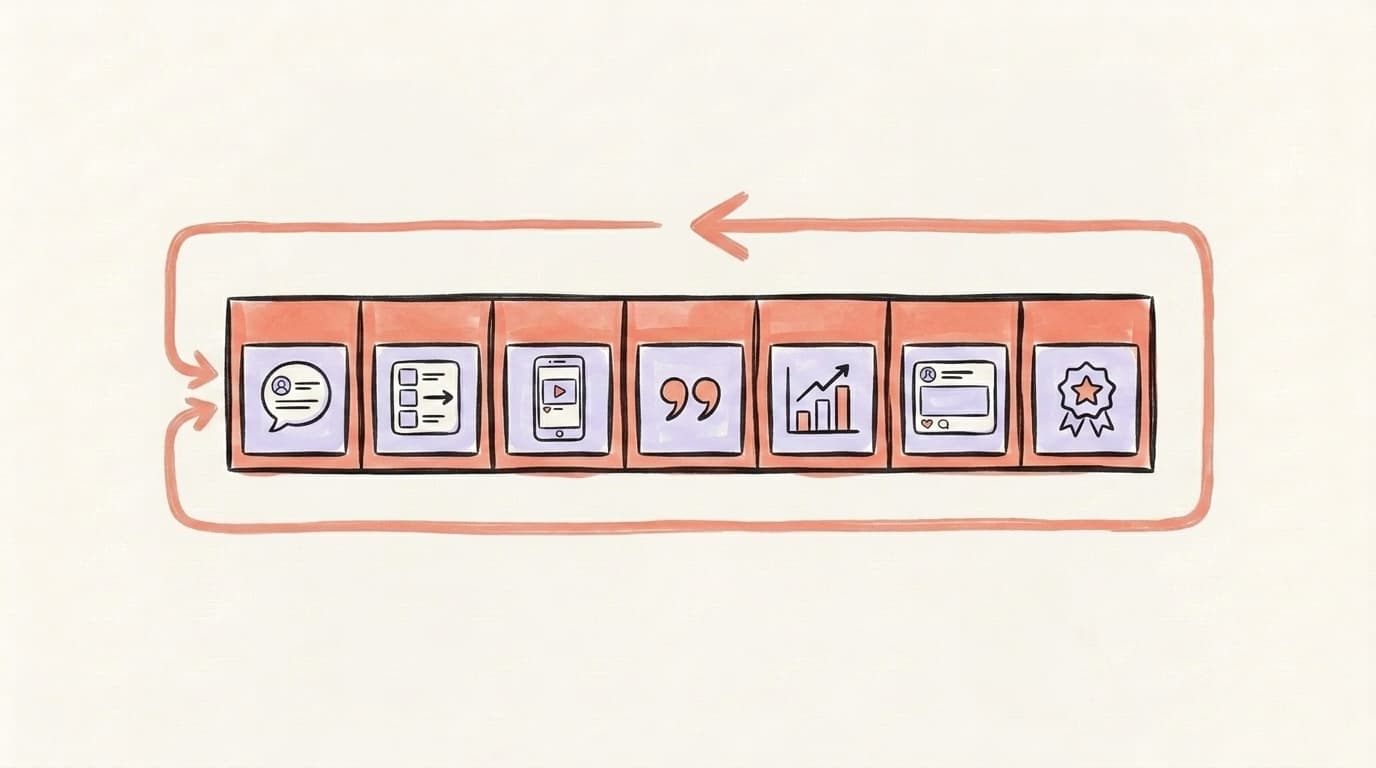
Repurposing content step by step works in five moves: pick the hub, extract the atoms, rewrite for platform, stagger the schedule, and track what lands. First, pick one long-form piece that took real effort — a blog post, a podcast episode, a webinar recording. Second, read or watch it with a notepad and pull out every standalone idea: stats, hot takes, examples, a counter-intuitive point, a mistake you made. Most decent long-form pieces contain 10 to 20 of these atoms. Third, rewrite each atom in the voice and shape of the target platform — X gets a hook plus punchline, LinkedIn gets a story with a lesson, Threads gets a casual observation. Fourth, stagger them. Don't dump the same idea across all three platforms within an hour; space the same idea four to seven days apart per platform. Fifth, tag which atoms performed and double down on those angles next time. That feedback loop is what turns repurposing from a hack into a strategy.
AI that learns your voice
Posts that actually sound like you
Postory's AI writes drafts in your voice — not generic AI mush — so you publish faster and still sound human.
How Do You Repurpose Blog Posts Into Social Media Content?
Repurposing a blog post into social media content starts with treating the post as a quarry, not a finished artifact. As a rule of thumb from our own content work at Postory, a typical 1,500-word article hides 5 to 10 pull-quote-worthy lines, 2 to 3 hot takes, a few stats, and at least one contrarian point inside it. Each of those is a post on its own. The mistake most creators make is publishing the blog, sharing the link once, and moving on — when the article itself is really a container for a dozen smaller ideas that each deserve their own moment. Your job isn't to summarize the post; it's to mine it. Read it with a highlighter in hand and mark every sentence that could stand alone, every number that surprised you, and every turn of phrase that made you hesitate before publishing. Those are the atoms. Turn each atom into its own platform-native post and you've bought yourself two weeks of content from one afternoon of writing.
Concrete moves that work every time:
- One-sentence hot takes — pull the spiciest claim, strip the caveats, post it as-is on X or Threads.
- Carousel breakdown — turn the H2s into slides. One slide per section, one idea per slide, end with a CTA back to the full post.
- Quote graphics — the pull-quotes become image posts for LinkedIn and Instagram.
- "I used to believe X, now I believe Y" — every good article has this pivot buried in it. Lift it.
- Email snippet — the intro of the post is usually a decent newsletter teaser with a link.
- Thread/long-form LinkedIn post — rewrite the whole article in 8-10 beats for a LinkedIn or X thread.
If you've never done this, pick your most-read post from the last six months and try to extract 10 posts from it in one sitting. You'll be surprised what's already in there.
How Do You Repurpose Video Content from YouTube, Webinars, and Reels?
Video is the richest source of repurposable content because it gives you both the script and the visuals at the same time. The workflow: pull the transcript, extract 5-7 quote-worthy lines, clip 3-4 short vertical segments (30-60 seconds each), and turn the outline into a written post. Tools like Opus Clip and Descript automate most of the clipping — you paste a long video, they auto-detect high-retention moments and export vertical cuts with captions baked in. For a 20-minute YouTube video, you should realistically get a written LinkedIn post, 3-5 short vertical clips for Reels/Shorts/TikTok, a quote carousel, an X thread recapping the key points, and at least one written hot take pulled from a standout line in the transcript. That's roughly 10 posts from a single recording session, and most of the adaptation work is mechanical once you've done it two or three times.
Maria Wendt has a solid walkthrough of turning one piece of content into 15 Instagram posts — the same principle applies to any platform:
The part most people miss: the short clips need their own hook in the first second. You can't just chop the middle out of a longer video and expect it to stop a scroll.
How Do You Repurpose Podcast Episodes?
Podcast episodes are under-repurposed because most hosts only post the full episode link and call it done. A single one-hour episode contains at least 15 distinct pieces of content. The move: get a timestamped transcript, highlight the quote-worthy moments, and turn each one into a standalone format. Audiograms (short audio clips with waveform visuals) work well on LinkedIn and Instagram. Pull-quote graphics work on all platforms. A written summary with the top 5 takeaways makes a clean LinkedIn post. The full transcript itself, edited down, becomes a blog post — which then becomes its own repurposing source. You're layering content into content, and that layering is what separates creators who "post a podcast" from creators who "run a content engine." One episode becomes a blog post plus around 10 social posts, and the blog post itself spawns another 10 — so a single recording can fan out into roughly 20 pieces if you do it right, and the incremental effort after the recording is mostly copy-paste plus light editing.
What Are the Platform-Specific Rules for LinkedIn, X, and Threads?
Platform-specific rules exist because copy-pasting the same post everywhere trains your audience to ignore you. Each platform has its own rhythm, ceiling, and reader expectation — and when you ignore that, even a genuinely good idea flops because it's wearing the wrong outfit. LinkedIn rewards stories with a setup, a turn, and a lesson — usually 150 to 300 words with line breaks between every sentence so the post reads like a scroll of individual beats. X rewards punchy single lines or threads with a clear hook and payoff structure; hedging language reads as weakness, so you strip it out. Threads sits between the two: more casual than LinkedIn, longer than X, reply-driven, and more forgiving of half-formed opinions that invite a conversation. The same idea — say, "junior PMs overvalue frameworks" — becomes a 250-word LinkedIn story, a one-line X hot take, and a Threads question asking what other people have seen. Here's the translation table:
- LinkedIn: add a personal story or context, break every sentence onto its own line, end with a question or lesson. 150-300 words.
- X: strip to the essential claim. Single tweet or a 5-8 tweet thread with a strong hook. Remove hedging language.
- Threads: conversational tone, ask for replies, shorter than LinkedIn, more opinion than X. Good for hot takes.
The same core idea gets three different delivery shapes. That's not deception — it's just respecting how people read on each platform.
What Does a Weekly Repurposing Workflow Look Like?
A weekly repurposing workflow takes about 3-4 hours and produces a full week of content across three platforms. The rhythm: Monday, create or pick one hub asset. Tuesday, extract 10-15 atoms into a single doc. Wednesday, rewrite each atom for LinkedIn, X, and Threads — that's 30+ posts in draft. Thursday, schedule them across the week with gaps between platforms. Friday, review what performed last week and note which angles to double down on. Most creators who run this consistently end up with a three-week backlog of scheduled content by month two, which is the first time publishing actually stops feeling urgent. You're no longer writing for today — you're writing for next week. That mental shift is the real payoff. The goal isn't to eliminate creative work; it's to cluster it into one chunk so you're not starting from a blank page on a Tuesday night at 9 PM.
How Do You Measure Repurposing ROI?
Repurposing ROI is measured by output per hour of creation, not per post. If you spent 2 hours writing a blog post and turned it into 12 social posts, your effective cost per post is 10 minutes — even though each individual post only took 2-3 minutes to adapt. Track three numbers over 30 days: total posts published, total hours spent creating, and which source assets produced the highest-engagement derivatives. The third metric is the most useful. You'll find 20% of your hub assets generate 80% of the winning posts. Lean into whatever those hubs have in common — it's usually a specific format (case study, hot take, teardown) or a specific topic wedge. Engagement per post is a noisy metric; engagement per hour of creation is the one that tells you whether your system is working. If you're spending less time and reaching more people than you were six months ago, it's working.
How Can AI Speed Up Content Repurposing?
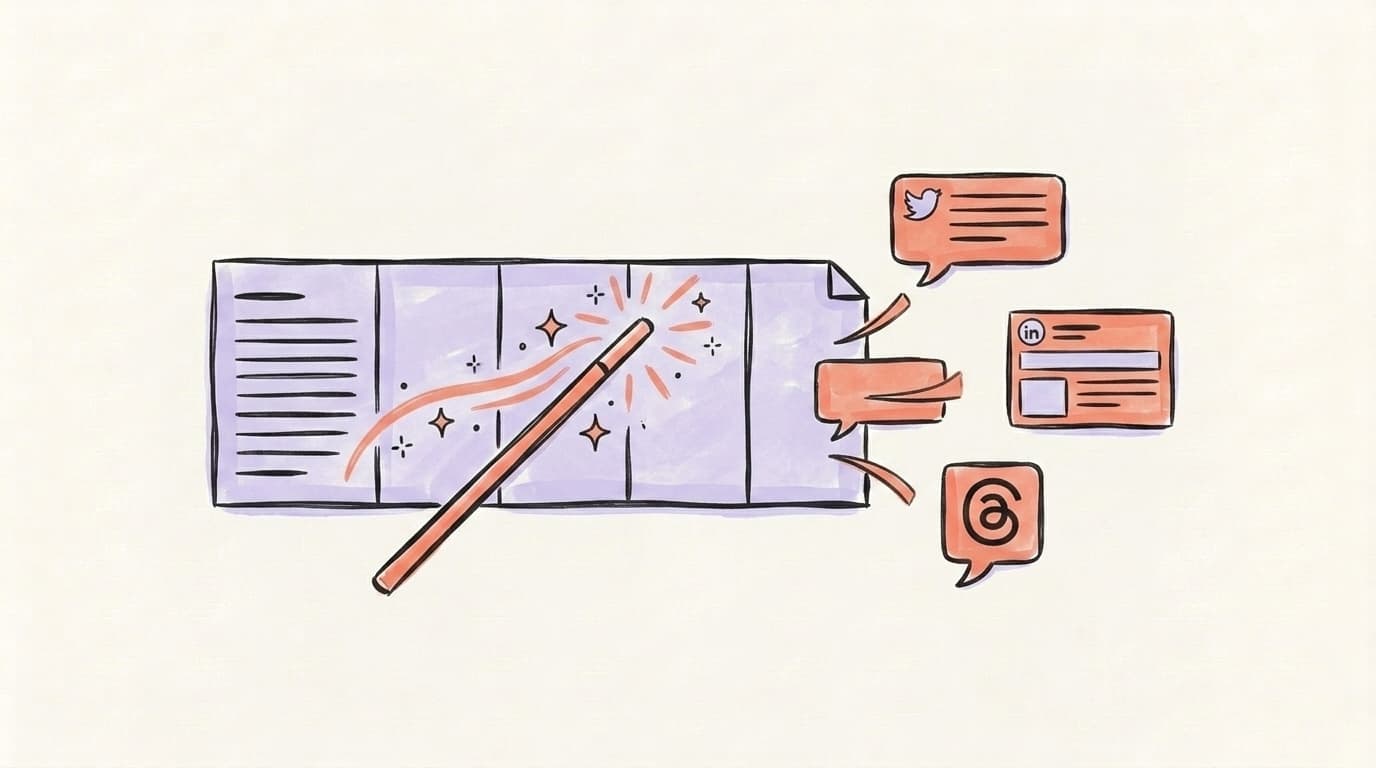
AI speeds up content repurposing by collapsing the "extract and rewrite" steps from hours to minutes. You paste a blog post, a YouTube transcript, or a podcast URL, and an AI model pulls the standalone ideas and drafts platform-specific versions. The output still needs human editing — AI tends to smooth out voice and over-hedge — but you skip the blank-page part, which is where most people stall. This is exactly what Postory does. You paste a URL, it pulls the content, and it generates platform-ready drafts for X, Threads, and LinkedIn in seconds. No copy-pasting between tabs, no re-prompting for each platform. The AI post writing feature is built specifically for this extract-and-rewrite loop. You still control the final voice — the AI just handles the mechanical translation between formats. For context on the fundamentals of why this works, see what is content repurposing.
Start repurposing content with Postory
Paste a URL, get 10 platform-ready posts in seconds. Instead of rewriting the same idea three times in three tabs, drop a blog post or YouTube link into Postory and get drafts for X, Threads, and LinkedIn side by side. Edit the tone, schedule the week, move on.
Try Postory free — turn one piece of content into a week of posts without leaving one tab.
FAQ
Q: How often should I repurpose the same content?
You can repurpose the same core idea every 3-6 months as long as the format, framing, or example changes. The audience rotation on most platforms is large enough that few people will notice, and even fewer will care if the post is genuinely useful. Don't repost identical copy within 30 days on the same platform.
Q: What's the difference between repurposing and reposting?
Reposting is publishing the exact same post again. Repurposing is taking the underlying idea and reshaping it for a different format, platform, or audience. Reposting trains your audience to skip your content; repurposing lets you reach people who missed the original.
Q: How many platforms should I repurpose to?
Three is the sweet spot for solo creators. Pick the platforms where your audience actually is — for most B2B creators that's LinkedIn, X, and Threads. Adding Instagram, TikTok, and YouTube on top is sustainable only if you have a video workflow or a team.
Q: Should I repurpose old content or only new content?
Old content is usually the best source because it's already been validated. If a post got strong engagement six months ago, it will almost certainly work again in a different format. Start your repurposing system on your top 10 posts from the last year before worrying about new hubs.
Q: How do I avoid sounding repetitive across platforms?
Change the format, the angle, or the example — ideally two of the three. Same core point, different story. On LinkedIn it becomes a career lesson, on X it becomes a one-liner, on Threads it becomes a question. Your regulars who follow you on all three will respect the variation, not flag it.
Q: What tools do I actually need for content repurposing?
At minimum: a writing tool (Notion, Google Docs), a scheduler that publishes to multiple platforms, and an AI assistant for drafting variations. That's it. Fancy video-clipping tools are useful if you make video, but if you're a text-first creator, you don't need them.
Q: How do I pick which piece of content to repurpose first?
Pick the one with the highest engagement in the last 90 days. If nothing stands out, pick the one that took you the most time to make — high-effort content almost always contains the most repurposable atoms. Start there, extract 10 posts, and you'll see the pattern for the rest.
Related articles
How to Use Content Repurposing Tools (And Which Ones Are Actually Worth It)
Content repurposing tools turn one piece of content into ten — but only if you pick the right one. Here's how to choose and use them.
Apr 26, 2026
How to Create Video Content for Social Media?
A practical 2026 guide to making social media videos that get watched, shared, and repurposed across LinkedIn, X, and Threads.
Apr 25, 2026
How to Cross-Post on Social Media?
A practical guide to cross-posting without tanking your reach — what to copy, what to rewrite, and which tools actually save time.
Apr 22, 2026