
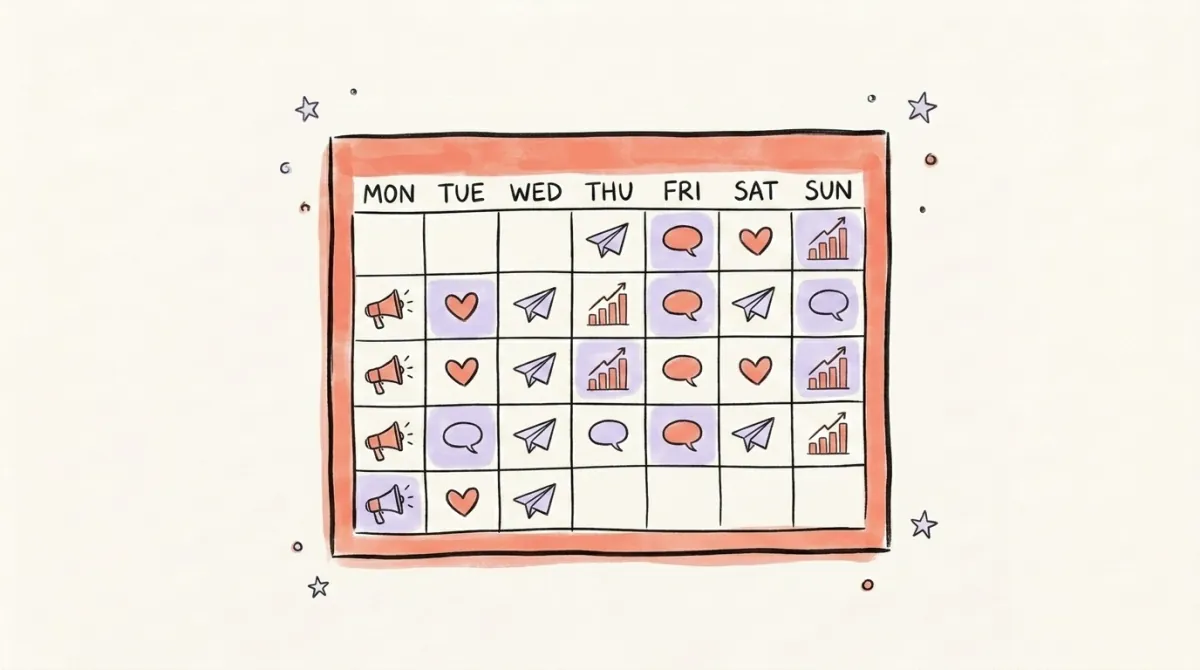
How Often Should You Post on Social Media?

There's no single answer to how often you should post on social media — each platform has its own sweet spot. Aim for 3–5 posts per week on LinkedIn, 1–3 per day on X, daily on Threads, and 3–5 per week on Instagram and Facebook. Consistency beats volume everywhere.
If you've ever felt guilty for not posting "enough" on social media, you're not alone. Between marketing gurus yelling about posting every waking hour and LinkedIn coaches preaching "quality over quantity," it's easy to freeze. Here's what the actual data says for each platform — and how to hit the right cadence without burning out.
What's the Ideal Posting Frequency for Each Platform?
There isn't one ideal posting frequency for social media — the right cadence depends entirely on the platform's algorithm, the lifespan of a single post, and how much patience your audience has for multiple updates per day. LinkedIn rewards 3–5 posts per week with a sharp lift in impressions, while X favors accounts that stay active multiple times a day because tweets burn out fast. Threads still rewards experimentation, and Instagram and Facebook sit somewhere in the middle — a few quality posts per week beats flooding the feed. According to Buffer's analysis of over 2 million LinkedIn posts, consistency and frequency are both measurable growth levers, but they work differently on each platform. The table below is your cheat sheet. The rest of this post explains the "why" behind each number so you can adapt it to your own audience.
| Platform | Minimum | Sweet spot | Max before diminishing returns |
|---|---|---|---|
| 2/week | 3–5/week | Not established; higher-frequency groups still gained impressions | |
| X (Twitter) | 1/day | 3–5/day | 10/day |
| Threads | 1/day | 2–3/day | 5/day |
| 3/week | 3–5/week + daily stories | >2/day | |
| 3/week | 5/week | 2/day |
How Often Should You Post on LinkedIn?
The sweet spot for LinkedIn is 3–5 posts per week, and the data on this is unusually clear. Buffer analyzed over 2 million LinkedIn posts across 94,000+ accounts and found that moving from one post a week to 2–5 gives you roughly +1,182 more impressions per post on average. Push it to 6–10 posts a week and you get about +5,001 more impressions per post, with a measurable engagement rate lift too.
Beyond that, Buffer's higher-frequency groups still averaged more impressions per post rather than fewer — its 11+ group averaged the largest gain over posting once a week — and that volume is only worth carrying if quality stays high. For most solo creators and small teams, 3 posts a week is the realistic ceiling that still leaves room for comment replies and DMs. Post on Tuesday, Wednesday, and Thursday morning in your audience's timezone and you'll catch LinkedIn's peak activity window.
Content calendar
Plan a month of content in an afternoon
Map out your posts on a visual calendar, batch your ideas, and never stare at a blank page again.
The other thing to know: on LinkedIn, how you post matters almost as much as how often. The platform rewards text-first posts, personal stories, and comments from the author on their own threads. A "quality" post here isn't a polished company update — it's a short first-person story, a contrarian take, or a specific number-heavy insight. If you can write three of those a week instead of five generic carousels, your engagement will be better.
How Often Should You Post on Twitter/X?
X is the outlier — post 1–3 times per day minimum, and 3–5 times a day if you're serious about growing. Tweets have a short lifespan: most of the engagement happens in the first 15–30 minutes after posting, so a single tweet per day is barely a blip on the timeline before it disappears. The X algorithm also rewards accounts that stay consistently active because it reads regular posting as a signal that you're a real person the platform should distribute, not a dormant account to ignore. Most active brand and creator accounts post multiple times per day, and that's the average — not the top performers. High-growth accounts often post 10+ times daily, but past that point you're either running a dedicated media operation or spamming. For most solo creators, 3 tweets a day hits the ceiling of what's sustainable without sacrificing quality.
Space your tweets out — don't dump five in a row. Two or three hours apart works well. Mix formats: a short one-liner, a reply to someone in your niche, a link out to your work, a longer text post, or an image. If you're worried about running out of ideas, thread replies and quote-tweets count too. For a deeper playbook, see our guide to growing on X/Twitter.
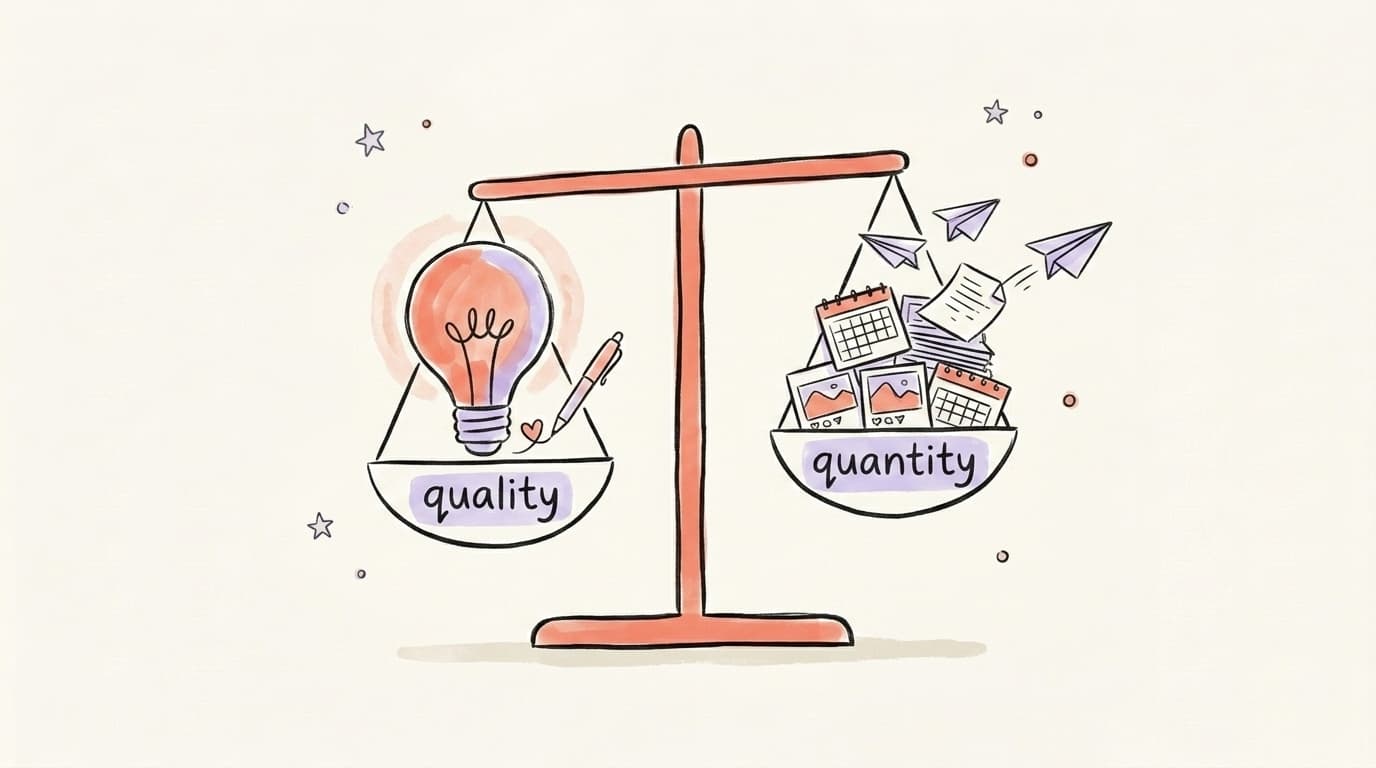
How Often Should You Post on Threads?
Threads still rewards experimentation — post 1–3 times per day and treat it as a lab. The platform is young enough that the algorithm hasn't settled into hard rules the way LinkedIn's and X's have, which means there's more room to find what works for your voice. From creator reports and our own testing, posts seem to have a short initial visibility window of roughly an hour or two, so spacing at least 4 hours apart lets each post finish its cycle before the next one competes for the same audience. Early reporting on the Threads algorithm suggests replies are weighted heavily — an account that posts twice and replies to 20 people tends to outperform one that posts 10 times and never replies back. If you're cross-posting from X or Instagram, that's fine as a starting point, but native-written threads consistently outperform raw imports. The tone on Threads skews more casual than LinkedIn and less reactive than X, so rougher drafts and half-formed observations often do better than polished takes.
The minimum to maintain visibility is roughly one post a day. Creators widely report that going quiet for a week noticeably hurts reach, and it takes a stretch of consistent posting to rebuild. The good news: low expectations on polish means you can ship rougher drafts here than you would on LinkedIn, which makes daily posting far less exhausting.
How Often Should You Post on Instagram and Facebook?
Both platforms land in the 3–5 posts per week range for feed content, with a daily Story or two layered on top. Instagram rewards consistency more than volume: posting 4 high-quality Reels a week will outperform 14 mediocre ones, because average watch time, saves, and shares weigh more in the algorithm than raw output does. Hootsuite's 2026 social media benchmarks actually found that 2 posts per week is the peak-engagement frequency for both Instagram and Facebook — a useful reminder that posting more isn't always better. Practitioner consensus is that 3–5 feed posts a week is a sustainable sweet spot for most brands and creators. Go much higher and you'll see per-post engagement drop as your audience sees the same account too often in a single scroll session. Stories are different — daily is fine and expected, since they expire in 24 hours and don't clutter the grid or compete with feed posts for distribution. Think of Stories as your always-on channel for quick updates and behind-the-scenes moments, while feed posts carry your best work.
Facebook is quieter these days, but the same cadence works. Aim for 3–5 posts a week if you have an active audience there, or 1–2 a week if Facebook is more of a secondary channel. Don't cross-post identical content between Instagram and Facebook — Meta's algorithm notices and suppresses the duplicate.
How Do You Stay Consistent Without Burning Out?
The fastest way to burn out on social media is to treat every post as a one-off. If you're writing Monday's LinkedIn post on Monday morning, you've already lost — that's the rhythm that turns social into a daily emergency instead of a system. Consistency comes from batching, repurposing, and building a small library of evergreen content you can rotate through when your week gets chaotic. The creators who sustain 3–5 weekly posts across multiple platforms for years aren't more disciplined than everyone else; they've just separated the "thinking about what to post" work from the "actually shipping it" work. Here's what actually works for solo creators and small teams juggling three or four platforms, distilled from the habits of people who've kept a consistent cadence for more than six months without quitting the whole thing in frustration.
Batch one day a week. Block 90 minutes to write 5–10 posts at once. Ideas flow better in a batch than in daily 15-minute panics. Save them in a simple doc or a content calendar.
Repurpose aggressively. One good LinkedIn post becomes three tweets, a Threads version, and an Instagram carousel. You're not plagiarizing yourself — you're distributing. Most of your audience only sees you on one platform anyway.
Lower the polish bar. LinkedIn and X both reward rawness more than most people realize. In our experience, a three-sentence observation with a specific number usually beats a designed carousel.
Skip the guilt days. Missing a Tuesday doesn't kill your account. What kills accounts is quitting for three months because one missed day spiraled into "I'm behind forever."
Matt Purcell has a short, honest walkthrough of realistic per-platform minimums that's worth 8 minutes if you want a second opinion before committing to a cadence:
How Can Scheduling Tools Help You Hit Your Frequency Goals?
Scheduling tools turn posting frequency from a willpower problem into a calendar problem, and that single reframe is what makes weekly cadences sustainable. Instead of remembering to post three times on LinkedIn this week, you write five posts on Sunday evening and queue them up for Tuesday, Wednesday, and Thursday at 9 AM. You show up consistently whether you feel like it or not on any given Tuesday — which is exactly what every platform's algorithm rewards. For creators juggling LinkedIn, X, Threads, and Instagram at the same time, a scheduler is the difference between "I post when I have time and remember" and "my cadence runs itself while I focus on replies." It also lets you batch your thinking once a week instead of context-switching into social mode four or five times a day, which is the quiet tax most creators underestimate until they burn out.
Schedule your ideal posting cadence across all platforms
Picking a frequency is the easy part. Hitting it every week for six months without burning out is where most people fall off. That's exactly what Postory is built for — you draft posts once, schedule them across X, Threads, and Bluesky, and let the queue run while you focus on the conversations your posts start.
Try Postory free — schedule a month of posts in one afternoon and never miss your cadence again.
FAQ
Q: How often should I post on social media per day?
It depends on the platform. On X, 3–5 times a day is the sweet spot. On Threads, aim for 1–3. On Instagram and Facebook, once a day is plenty for feed posts, plus daily Stories if you use them. On LinkedIn, you rarely need more than one post per day.
Q: Is posting every day on social media too much?
On some platforms, yes. LinkedIn is not one of the clear cases: in Buffer's study, accounts posting 6–10 and 11+ times a week averaged higher impressions per post than accounts posting once a week. On X, Threads, and Instagram Stories, daily (or more) is the norm. The better question is whether you can sustain daily output at good quality — if not, post less and post better.
Q: What happens if I post too often on one platform?
It varies by platform, and LinkedIn is not the clear case it's often made out to be: Buffer measured higher impressions per post at 6–10 and 11+ weekly posts, not lower. On Instagram, posting more than once or twice a day can cannibalize your own reach — your second post competes with the first one for the same audience before it's finished delivering.
Q: Can I post the same content on every platform?
You can, but it's rarely the best move. Each platform has its own format, tone, and length norms. Repurposing (rewriting the same idea for each platform) works far better than raw cross-posting. A LinkedIn post becomes a thread on X, a single Threads post, and a carousel on Instagram.
Q: How long should I test a posting frequency before judging results?
Give it 30 days minimum. Social media algorithms adjust slowly, and a single week of data is mostly noise. Track impressions, engagement rate, and follower growth week over week for a full month before deciding your cadence is working or not.
Q: Does posting on weekends hurt engagement?
Usually, yes — on LinkedIn especially. B2B audiences are mostly offline on weekends, and impression volume drops sharply. On X, Threads, and Instagram, weekends can actually work well for consumer-facing content, but engagement times shift later in the day.
Q: What's more important: frequency or quality?
Quality wins in a tie, but frequency is what gets you to "good enough" quickly. You can't edit your way to a strong social presence from zero posts a week. Start with a sustainable cadence, ship at medium quality, and refine as you learn what resonates.
Related articles
What Is Mastodon Social Media? A Beginner’s Guide
What is Mastodon social media? Learn why it was created, how servers and the fediverse work, and whether this decentralized network suits you.
Oct 15, 2026
What Is Bluesky? How It Works, Users, Pros & Cons
What is Bluesky? How the social app works, who it is for, and its pros and cons. Learn its history, AT Protocol, feeds, and latest user count.
Oct 15, 2026
Threads vs X (Twitter) 2026: Which Is Better for Creators?
Threads vs Twitter/X in 2026 — audience, algorithm, monetization, ads, account safety, tools, and the cross-posting workflow creators actually use.
Aug 15, 2026